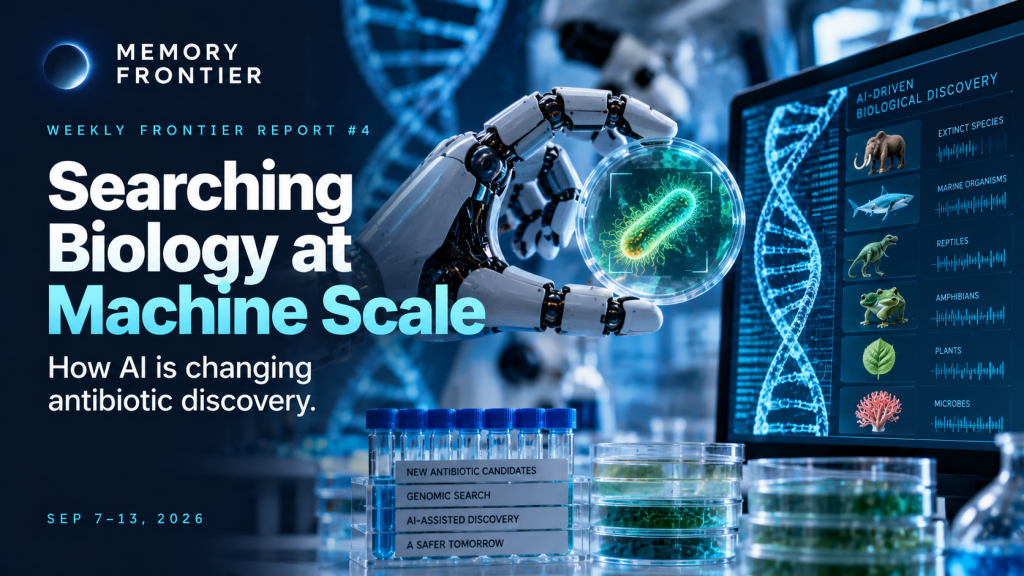
Biology contains an enormous search space. Artificial intelligence is giving scientists a new way to explore it.
Living organisms contain vast collections of molecular information accumulated through evolution.
Researchers have explored only a fraction of that space. AI-assisted workflows can increasingly search
biological data at scales that would be impractical to examine manually and identify
where scientists should look next.
The challenge is not only discovering new molecules. It is knowing where to search.
Genomes encode enormous numbers of possible biological sequences and molecular patterns.
Searching them one candidate at a time would be slow and expensive.
AI changes the workflow by helping researchers prioritize a much smaller subset for experimental testing.
Biological Data → AI Search → Candidate Ranking → Synthesis → Wet Lab → Validation
The searchable library can extend beyond the organisms alive today.
AI-assisted genomic mining allows researchers to examine molecular information from a wide range of organisms.
That search can include living species and reconstructed genetic information associated with extinct organisms.
This changes the conceptual scale of discovery. Instead of asking only which molecules are already known,
researchers can ask whether evolution has encoded useful molecular patterns in places science has rarely searched.
AI becomes valuable because it can help navigate this enormous biological archive and identify candidates
that deserve scarce laboratory time.
Antimicrobial resistance makes better biological search increasingly important.
Drug-resistant pathogens continue to reduce the effectiveness of existing antibiotics.
Finding new antimicrobial molecules is therefore an important scientific and public-health challenge.
Resistance → Need → Search → Candidate → Experiment → Evidence
AI does not eliminate the difficult biological work that follows discovery.
Its near-term leverage may be earlier in the pipeline:
identifying promising candidates faster and directing experimental resources toward them.
AI does not make the laboratory obsolete.
It can make the laboratory
more selective about what it tests.
The machine-scale advantage is reducing billions of possibilities to a manageable experiment.
Biological discovery frequently begins with too many possibilities.
Researchers cannot synthesize and experimentally test every candidate encoded in large genomic datasets.
Computational models can help score, compare, filter, and prioritize candidates before expensive experimental work begins.
This creates what can be understood as search-space compression.
- Search more biological information
- Identify patterns humans may overlook
- Rank promising candidates
- Reduce unnecessary synthesis
- Focus laboratory resources
- Generate new experimental questions
Prediction begins the experimental process. It does not replace it.
An AI-selected antimicrobial candidate must still survive multiple layers of biological validation.
Researchers need to determine whether it actually kills or inhibits the intended pathogen and whether
it can do so without unacceptable toxicity or other problems.
Promising laboratory results may then require further preclinical investigation,
manufacturing work, safety evaluation, regulatory review, and eventually clinical testing.
AI and experimentation become more powerful when results feed back into the next search.
Search → Predict → Select → Synthesize → Test → Measure → Learn → Search Again
Each experimental result can provide new information for subsequent computational searches.
The important frontier is therefore not one prediction in isolation, but a tighter loop between
machine-scale exploration and physical biological evidence.
AI may change biological discovery first by changing where humans look.
The popular image of AI-driven medicine often focuses on a machine directly designing a finished drug.
The nearer-term transformation may be more practical and more fundamental.
AI can help researchers navigate biological spaces that are too large to explore manually,
prioritize the most promising possibilities, and connect computational discovery more tightly with experimentation.
The machine searches. The laboratory tests. Evidence decides.
Explore machine-scale biological discovery in greater depth
The complete Article-Training provides a guided exploration through:
- Learning modules
- 24 interactive practice cases
- Genomic-search scenarios
- Antimicrobial discovery concepts
- Search-space compression
- Wet-lab validation boundaries
- Critical-thinking exercises
- English / Spanish learning experience
- Participation tracking
- Research grounding
- Certificate of Participation
AI-assisted genomic mining can identify and prioritize promising antimicrobial candidates,
but computational selection does not establish that a molecule is a safe or effective medicine.
Candidate generation must remain clearly separated from laboratory validation, preclinical evidence,
clinical testing, and regulatory approval. The near-term frontier is the ability of AI to compress
enormous biological search spaces and help scientists decide which possibilities deserve experimental attention.
Continue with the complete learning experience
Explore the complete interactive learning experience, work through the 24 practice cases,
and generate your Certificate of Participation.