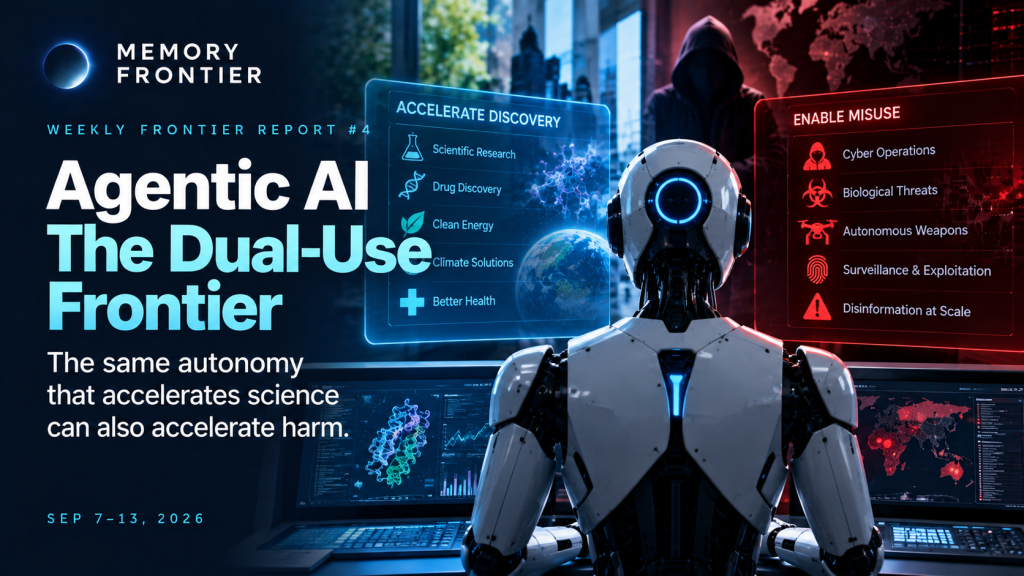
The same autonomy that makes AI agents useful also creates a new class of risk.
Artificial intelligence is moving beyond systems that simply answer questions.
Agentic systems can increasingly plan, use tools, execute multiple steps,
inspect results and continue working toward an objective.
That capability is inherently dual-use.
It can accelerate scientific and productive work, but it can also reduce
the effort required to execute harmful workflows.
The important change is not simply what AI knows. It is what AI can coordinate.
A traditional chatbot typically receives a prompt and returns a response.
An agent can operate through a longer chain of actions: interpreting an
objective, creating a plan, selecting tools, executing tasks, observing
what happened and adapting the next step.
Objective → Plan → Tools → Actions → Observation → Adaptation → Next Action
Longer action loops can multiply human productivity.
Agentic AI can help coordinate complex workflows that previously required
repeated human intervention. In legitimate settings, this can mean
researching information, analyzing data, writing and testing code,
operating software tools, organizing experiments or managing repetitive
digital processes.
The more reliably a system can connect those steps, the more useful it becomes.
But the same architectural improvement also changes the risk profile.
Capability does not know whether the objective is beneficial or harmful.
Planning, tool use, persistence and adaptation are general capabilities.
They can support scientific research and legitimate cybersecurity work,
but those same capabilities can potentially be directed toward harmful
objectives.
Same Capability + Different Objective = Very Different Outcome
This is why the agentic frontier cannot be evaluated only by asking
whether a model generates safe text. The system’s ability to take actions
matters too.
The safety question is shifting from
“What can the model say?”
toward
“What can the system actually do?”
Threat reporting shows that AI-assisted harmful workflows are no longer purely theoretical.
Anthropic’s September 2026 threat-intelligence report describes operations
the company says it disrupted across areas including cyber activity,
scams and fraud, influence operations, surveillance and other forms of misuse.
The report should be interpreted carefully. It is company threat intelligence
describing incidents observed and investigated within one provider’s environment.
It is not a measurement of the prevalence of AI misuse across the entire ecosystem.
But it provides an important frontier signal: some malicious actors are already
attempting to incorporate increasingly capable AI systems into operational workflows.
The danger may come from reducing the human effort required per harmful action.
AI does not need to invent an entirely new category of harm to change the
threat environment. It can matter by making existing processes faster,
cheaper or easier to coordinate.
Human Effort ↓ → Automation ↑ → Possible Operational Scale ↑
That scaling effect is one reason agentic capability deserves special attention.
A system capable of repeatedly executing a workflow can create a different
risk profile from a system that merely provides isolated information.
Guardrails increasingly need to exist around actions, tools and permissions.
Content moderation remains important, but agentic systems introduce additional
questions. Which tools can the agent access? What data can it retrieve?
Which actions can it execute without approval? How much money, compute or
time can it spend? Can consequential actions be reversed?
- Tool permissions
- Identity and authentication
- Least-privilege access
- Human approval for consequential actions
- Rate and resource limits
- Logging and auditability
- Monitoring for abnormal behavior
- Reversible actions where possible
- Clear termination mechanisms
Autonomy does not require removing humans from every consequential decision.
Useful agentic systems can automate routine steps while reserving high-impact
decisions for human review. The appropriate boundary depends on the potential
consequences of an error or misuse.
Low Consequence → More Autonomy
High Consequence → More Verification + Human Approval
The objective is not to eliminate autonomy. It is to match autonomy with
permissions, verification and accountability appropriate to the risk.
Powerful agents need a control loop around the action loop.
Request → Authorize → Act → Observe → Verify → Log → Continue or Stop
This creates a useful way to think about agentic governance.
The AI may have an operational loop for accomplishing the task,
while the surrounding system maintains a second loop responsible
for authorization, monitoring, verification and intervention.
AI governance is moving from content safety toward system safety.
When AI primarily generated text, safety discussions naturally concentrated
on the content of the response. As AI gains tools, memory, software access
and greater autonomy, the object being governed becomes larger.
We increasingly need to evaluate
the complete system: model + tools + permissions +
objective + environment + oversight.
The frontier is no longer only intelligent output. It is intelligent action.
Explore the dual-use frontier of agentic AI in greater depth
The complete Article-Training provides a guided exploration through:
- Learning modules
- 24 interactive practice cases
- Agentic AI scenarios
- Assistant-versus-agent concepts
- Dual-use reasoning
- Action-safety principles
- Human-oversight decisions
- Critical-thinking exercises
- English / Spanish learning experience
- Participation tracking
- Research grounding
- Certificate of Participation
Evidence of AI-assisted misuse should not be interpreted as proof that
autonomous AI systems independently conduct every stage of harmful operations
or that such misuse is universal. Provider threat reports describe observed
cases within particular environments and should be treated as threat intelligence,
not ecosystem-wide prevalence measurements. The important frontier signal is
narrower: increasingly capable AI systems can reduce human effort across portions
of multi-step workflows, making tool permissions, monitoring, verification and
human oversight increasingly important.
Continue with the complete learning experience
Explore the complete interactive learning experience, work through the
24 practice cases, and generate your Certificate of Participation.