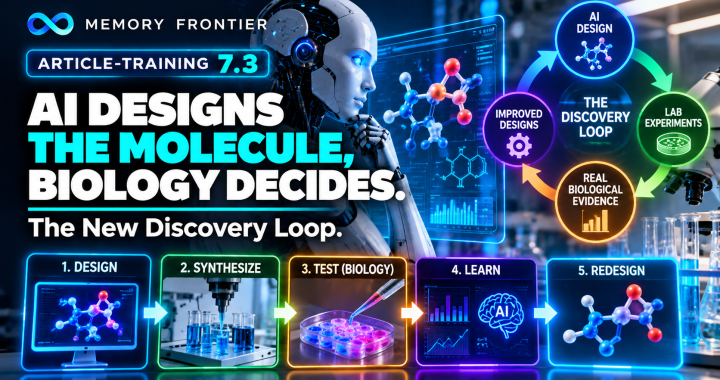
AI can simulate aspects of a cell. It still needs biology to tell it when it is wrong.
The frontier is not a fully solved digital cell. It is the construction of experimental datasets and validation systems capable of testing cellular predictions across interventions, cell types and laboratories.
The virtual cell is a testable scientific hypothesis, not a digital organism.
Computational models can predict aspects of cellular behavior from measured data. They do not reproduce every molecular interaction, tissue context, or disease process. The useful question is not whether a virtual cell looks realistic, but whether its predictions survive independent experiments.
Prediction ≠ Experiment ≠ Clinical proof
To predict a response, scientists must measure what happens when a cell is changed.
Perturbation experiments may involve altering gene activity, adding a compound, or changing the cellular environment. Recording both the intervention and the observed response creates training and evaluation evidence. Without controlled perturbations, correlations can be mistaken for mechanisms.
Intervention → Measurement → Comparison
More data is not automatically better data.
Experiments performed across laboratories can differ in cell type, protocol, dose, timing, measurement platform, and quality control. Shared metadata and reference standards make datasets more comparable, although they cannot remove all experimental variation.
Common protocols + Metadata + Quality controls
A model that memorizes familiar cells may fail on new biology.
Strong evaluation should test held-out cell types, interventions, laboratories and biological contexts. A high score on a narrow benchmark does not establish reliable performance across human tissues or diseases.
Training performance ≠ Out-of-distribution reliability
Prediction becomes useful when experiments can prove it wrong.
A model proposes a cellular response; a laboratory measures the outcome; scientists compare prediction and observation; the discrepancy informs a revised model. Reproducible negative results are especially valuable because they expose blind spots.
Predict → Perturb → Measure → Validate → Update
Every result needs a traceable history.
Reliable evidence pipelines preserve sample origin, protocol version, instrument settings, data transformations, controls and uncertainty. Traceability helps identify whether a surprising result reflects biology, batch effects or processing errors.
Traceability + Reproducibility + Auditability
A useful cellular prediction is not a validated treatment.
Results in cell lines or laboratory-grown systems do not automatically generalize to tissues, whole organisms or patients. Safety, pharmacology, clinical efficacy and regulatory review remain distinct stages.
Cell model → Preclinical evidence → Clinical evaluation
The strategic bottleneck may shift from model size to validated feedback.
As modeling capacity expands, standardized experiments and well-governed data may become increasingly valuable. A promising incubator opportunity is software and laboratory infrastructure that connects interventions, outcomes, provenance, uncertainty and model improvement. This is a thesis to test, not an established market outcome.
The valuable asset is validated learning, not prediction volume
A virtual cell is not a validated virtual human.
The October 2026 research initiative signals investment in shared data and modeling infrastructure. It does not establish that a universal virtual cell already exists, that all cellular responses can be predicted, or that the announced commitments are entirely new funding.
Explore the complete Virtual Cell Article-Training
The full interactive lesson includes 8 learning modules, 24 A/B/C practice cases, experimental perturbation data, model generalization, scientific provenance, clinical evidence boundaries, English/Spanish controls and a Certificate of Participation.
The underlying research direction concerns data generation, model development and independent experimental validation. Research programs and funding announcements should not be confused with clinical proof. See the original Weekly Frontier Report #8 for the dated research context.
Continue with the complete learning experience
Explore the eight modules, complete the practice cases and generate your participation certificate.