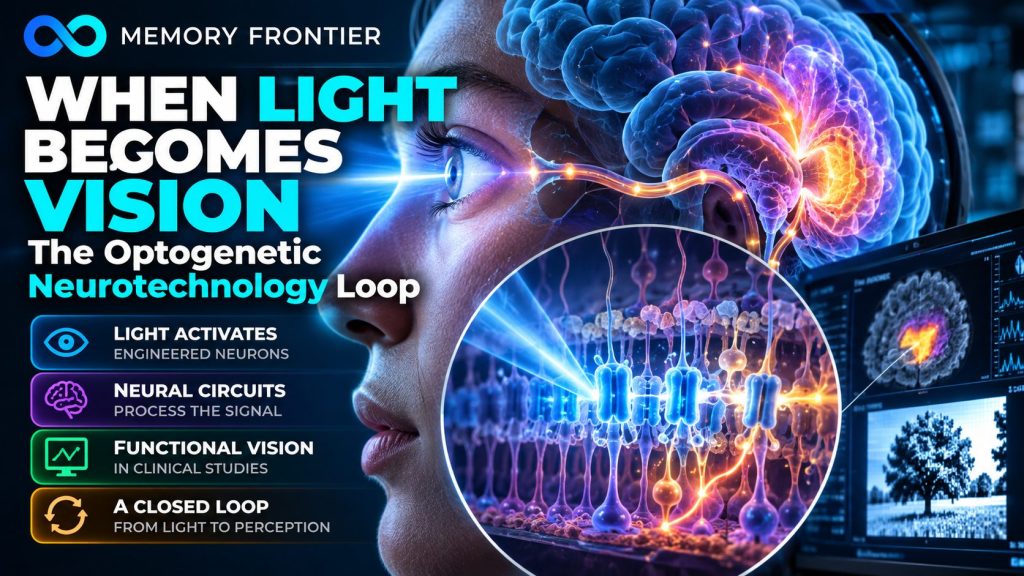
When Light Becomes Vision: The Optogenetic Neurotechnology Loop
What if restoring useful vision required teaching surviving retinal cells to respond to light differently?
Optogenetic vision restoration combines biological intervention with an external light-processing device. Instead of replacing an entire damaged retina, researchers aim to make surviving retinal cells responsive to carefully controlled light signals. The emerging lesson is that biological repair and engineered assistance may work together—but meaningful recovery must be demonstrated in people, not assumed from technical feasibility.
When photoreceptors fail, the visual pathway may still contain usable cells.
In certain advanced retinal diseases, the light-sensing photoreceptors deteriorate while some downstream retinal neurons remain. Optogenetic strategies investigate whether these surviving cells can be made light-sensitive, potentially restoring a limited pathway for visual information.
A light-sensitive protein becomes part of a new signaling route.
The intervention aims to introduce genetic instructions for a light-responsive protein into selected surviving retinal cells. The therapeutic goal is to enable those cells to react to optical stimulation. This does not recreate all the sophisticated processing performed by healthy photoreceptors.
Surviving retinal cells + light-sensitive protein → potential visual signal
Specialized glasses help translate scenes into optical stimulation.
A camera-based wearable system can capture the surrounding environment and convert visual information into a light pattern suitable for the modified retinal cells. The wearable device is not an ordinary pair of glasses: it is an active component of the experimental therapy.
The intervention changes how cells respond.
The device changes how light is delivered.
Clinical testing determines whether vision improves.
Vision restoration is a coordinated biological and computational system.
The loop links scene capture, image processing, optical stimulation, retinal response and human perception. Each component can affect the outcome. Improvements to the software or hardware may help, but they cannot automatically overcome biological limitations.
Scene → Camera → Processing → Light → Retina → Perception
Functional outcomes matter more than futuristic demonstrations.
Researchers must evaluate visual sensitivity, the ability to detect or localize objects, everyday usability, device dependence and safety. A statistically or clinically meaningful improvement in a study does not necessarily translate into independent navigation, reading or normal sight.
Small early clinical studies establish possibility—not universal effectiveness.
Early clinical results described in the Weekly Frontier #8 research brief suggest that optogenetic approaches can produce measurable visual improvements in some participants with advanced vision loss. However, small study populations, limited controls and variation among participants constrain conclusions. Long-term safety and practical benefit require continued follow-up and stronger studies.
This is not mind-reading or a brain-computer interface that decodes thoughts.
The technology targets retinal light processing and visual perception. It is related to neurotechnology and sensory restoration, but it should not be confused with implanted brain interfaces that decode neural activity to control computers or robotic devices.
The future may belong to carefully validated bio-digital therapeutic systems.
The larger opportunity lies in integrated therapies: biological interventions combined with software, sensing, wearables, calibration and measurable patient outcomes. The key challenge is proving that the combined system works reliably and safely in the intended population.
Partial visual improvement is not restored normal sight.
Clinical promise should be described in terms of the actual measured outcomes, participant numbers, adverse events and study limitations. Optogenetic retinal therapies remain experimental; a promising signal is not regulatory approval or a cure for blindness.
Explore the science behind light-based visual restoration.
Continue into our guided bilingual learning experience covering retinal biology, optogenetics, wearable image processing, clinical outcomes, patient safety and the emerging bio-digital therapeutic loop.
- 8 learning modules and 24 interactive practice cases
- English / Spanish learning experience
- Participation tracking and Certificate of Participation
- Evidence boundaries and practical interpretation
When Light Becomes Vision
Study the science, complete the interactive exercises and explore how evidence determines the real-world value of emerging neurotechnology.