A robot can perform an experiment.
But can the entire system prove that the result is trustworthy?
Artificial intelligence and robotics are beginning to reshape scientific laboratories. Machines can assist with sample handling, experimental planning, instrument operation and data analysis. But the deeper opportunity is not simply faster automation. It is building laboratories that produce reproducible, traceable and independently verifiable scientific evidence.
Executing laboratory instructions is only the first step.
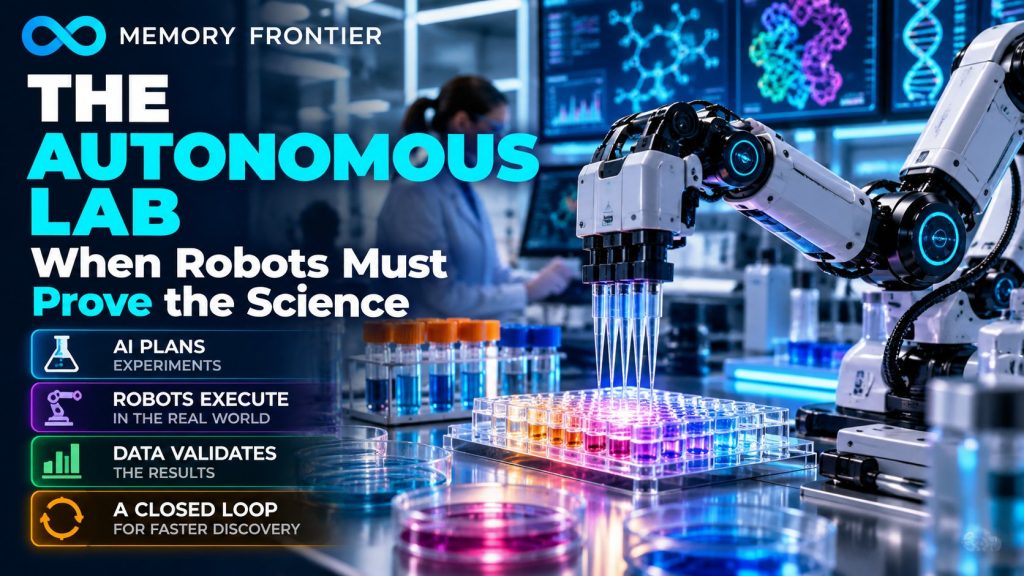
Traditional laboratory automation follows predefined procedures. More autonomous systems can potentially select experiments, coordinate instruments, interpret results and propose subsequent tests.
Automation → Coordination → Adaptation → Validation
Scientific discovery becomes a closed-loop process.
An AI system can formulate a testable hypothesis, recommend an experimental protocol, coordinate robotic execution and analyze the resulting measurements. Each result informs the next experiment.
Hypothesis → Plan → Execute → Measure → Verify → Learn
Physical manipulation and scientific interpretation are different capabilities.
A robot may successfully move a sample while a scientific model incorrectly interprets the experiment. Reliable autonomous laboratories must connect physical operations, instrument readings, metadata and analytical conclusions.
Correct movement does not automatically produce correct science.
The future autonomous laboratory must do more than perform experiments.
It must produce evidence that survives verification.
Simulation can help robots prepare for the physical laboratory.
Digital twins and learned world models can represent laboratory equipment, workflows and possible physical interactions. They may help evaluate proposed actions before execution, reducing some operational risks and improving planning efficiency.
Simulate → Check → Execute → Compare
However, simulated success is not proof of reliable real-world performance. Models must be calibrated and tested against actual laboratory conditions.
Every scientific result needs a verifiable history.
Reliable laboratory systems should record sample identity, instrument settings, software versions, environmental conditions, calibration records, timestamps, protocol changes and measured outcomes.
Sample → Protocol → Instrument → Measurement → Audit Trail
A successful experiment must withstand repetition and independent review.
Autonomous laboratories should not be judged only by the number of experiments performed. More meaningful metrics include repeatability, measurement uncertainty, protocol adherence, failure detection and agreement with independent testing.
Throughput ≠ Reproducibility ≠ Scientific Validity
Autonomy requires boundaries, permissions and stopping mechanisms.
Scientists and laboratory operators must define acceptable operating conditions, approve high-risk procedures and retain the ability to interrupt experiments. Systems need mechanisms for detecting anomalies, handling unexpected observations and escalating decisions.
Permission → Execution → Monitoring → Intervention
The competitive advantage may shift from robotic hardware toward validated learning systems.
A laboratory that executes experiments rapidly but produces inconsistent data has limited scientific value. A system that connects robotic operations with reliable measurements, structured data and reproducible feedback can create a foundation for accelerated discovery.
The strategic asset may be the complete experimental learning loop, not the robot alone.
Science is moving toward more connected, measurable and potentially self-improving infrastructure.
The opportunity spans materials science, energy research, biotechnology and advanced manufacturing. Shared experimental infrastructure could help research teams reuse validated procedures and compare results across facilities.
The emerging thesis is robotic execution + structured experimental evidence + independent verification + iterative learning.
A funded research program is not a fully autonomous laboratory.
The October 2026 U.S. Department of Energy project selections signal serious investment in scientific robotics. They do not establish that the proposed systems have already achieved general-purpose laboratory autonomy or independently verified scientific discovery at scale. The distinction between planned capability and demonstrated performance remains essential.
Explore autonomous scientific laboratories in greater depth
The complete Article-Training provides a guided exploration through:
- 8 learning modules
- 24 interactive practice cases
- Automation versus scientific autonomy
- Closed-loop experimental systems
- Robotics and scientific reasoning
- Digital twins and world models
- Laboratory data provenance
- Reproducibility and independent verification
- Human oversight and operational safety
- Evidence-driven scientific infrastructure
- English / Spanish learning experience
- Participation tracking
- Certificate of Participation
Scientific robotics, automated experimentation and AI-assisted research are active areas of development. The October 2026 project announcements describe planned research directions rather than established universal capabilities. Claims about increased discovery speed, reproducibility or autonomous performance require direct experimental evidence and independent evaluation.
Continue with the complete learning experience
Explore the interactive learning experience, work through the 24 practice cases and generate your Certificate of Participation.