AI can generate a molecule in seconds.
Biology still gets the final vote.
Generative models can explore chemical space at extraordinary scale, proposing structures that humans might never have designed manually.
But a computationally interesting molecule is not automatically a drug.
The decisive frontier is the loop connecting AI design with experimental biological evidence.
Generating a plausible molecule is not the same as discovering a medicine.
Modern generative systems can propose enormous numbers of candidate molecular structures.
Those structures can be novel, chemically formatted and computationally attractive.
Generation ≠ Validation ≠ Medicine
A molecule can score well computationally and still fail experimentally.
Validity, uniqueness, novelty and diversity are useful ways to evaluate a molecular generator.
But they do not tell us whether a compound actually binds the intended target, works in cells, avoids toxicity or can become a manufacturable drug.
The frontier therefore shifts from
“How many molecules can AI generate?”
toward
“How many useful hypotheses survive experimental testing?”
Structure-based AI can design around the three-dimensional geometry of a biological target.
When a model receives information about a target’s three-dimensional structure, it can generate or optimize molecules around a particular binding site.
This adds meaningful physical context to molecular generation — but docking scores and computational predictions remain approximations.
The laboratory still has to test whether the interaction actually occurs.
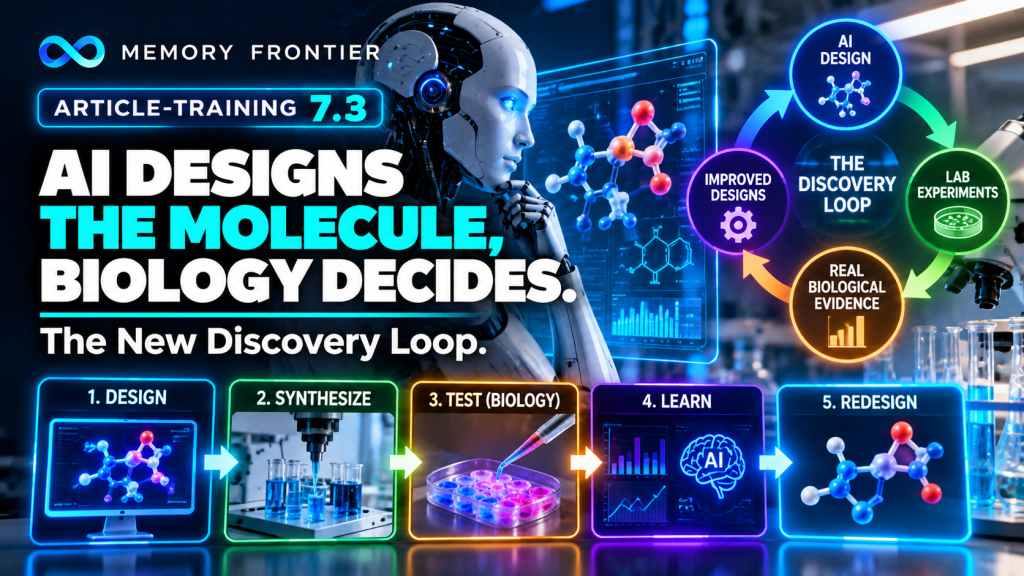
AI proposes.
Chemistry builds.
Biology tests.
And the result becomes
new information for the next design.
The strongest binder is not automatically the best drug candidate.
A useful candidate may need to balance potency, selectivity, solubility, permeability, metabolic stability, toxicity risk and manufacturability.
Potency + Selectivity + ADME + Safety + Manufacturability
Improving one property can degrade another.
That makes drug discovery a multi-objective optimization problem rather than a single-score competition.
Experimental evidence determines which computational predictions survive contact with reality.
Promising candidates can be synthesized and tested through biochemical or biological assays.
Those experiments produce measurements rather than predictions.
Design → Synthesize → Assay → Learn → Redesign
The experimental result then becomes new evidence that can guide model comparison, candidate selection and the next design cycle.
A failed molecule can still improve the discovery system.
Negative experimental results can expose blind spots in computational models, reveal unexpected chemistry and prevent repeated exploration of unproductive regions of chemical space.
If the system captures those failures correctly,
failure becomes feedback rather than waste.
Activity in an early assay is still very far from an approved medicine.
Promising activity must survive increasingly demanding layers of validation: cellular systems, pharmacokinetics, toxicity studies, preclinical models and eventually human clinical trials.
Molecule → Assay → Cells → Preclinical → Clinical
At every stage, biology can invalidate an apparently promising computational hypothesis.
As molecular generation becomes cheaper, validated experimental feedback may become the scarce asset.
Generating another million virtual molecules may become relatively easy.
Generating high-quality experimental evidence about which hypotheses actually work remains expensive and difficult.
This suggests a different competitive advantage:
systems that connect AI design tightly to fast, reproducible experimental learning loops.
The frontier is moving from AI-generated molecules toward AI-driven experimental learning.
The strategic advantage may not belong to the system capable of generating the largest number of molecular candidates.
It may belong to the system that learns fastest from real biological evidence.
The emerging thesis is
AI design + automated experimentation + validated feedback + rapid redesign.
AI-generated does not mean clinically validated.
Generative systems can propose and optimize molecular candidates, but computational generation alone does not establish biological efficacy, safety or clinical success.
Experimental validation remains essential, and promising early results can still fail during later stages of drug development.
Explore the new AI + biology discovery loop in greater depth
The complete Article-Training provides a guided exploration through:
- 8 learning modules
- 24 interactive practice cases
- Generative molecular design
- Structure-based drug discovery
- Computational metrics versus biological evidence
- Multi-objective lead optimization
- Wet-lab validation
- Learning from negative results
- Translational validation
- Closed-loop AI + laboratory discovery
- English / Spanish learning experience
- Participation tracking
- Certificate of Participation
Generative and structure-based AI systems can propose and optimize molecular candidates and can be evaluated against increasingly realistic benchmarks.
That evidence should not be interpreted as proof that AI-generated compounds will reliably become approved medicines.
Experimental biology, toxicology, pharmacology and clinical trials remain essential stages of validation.
Continue with the complete learning experience
Explore the complete interactive learning experience, work through the 24 practice cases, and generate your Certificate of Participation.