What if the brain did not need to communicate every detail of an idea?
What if it only needed to communicate enough intent for AI to help complete it?
That is the important transition emerging at the intersection of
brain-computer interfaces and generative AI.
The BCI captures a limited but meaningful signal of human intent.
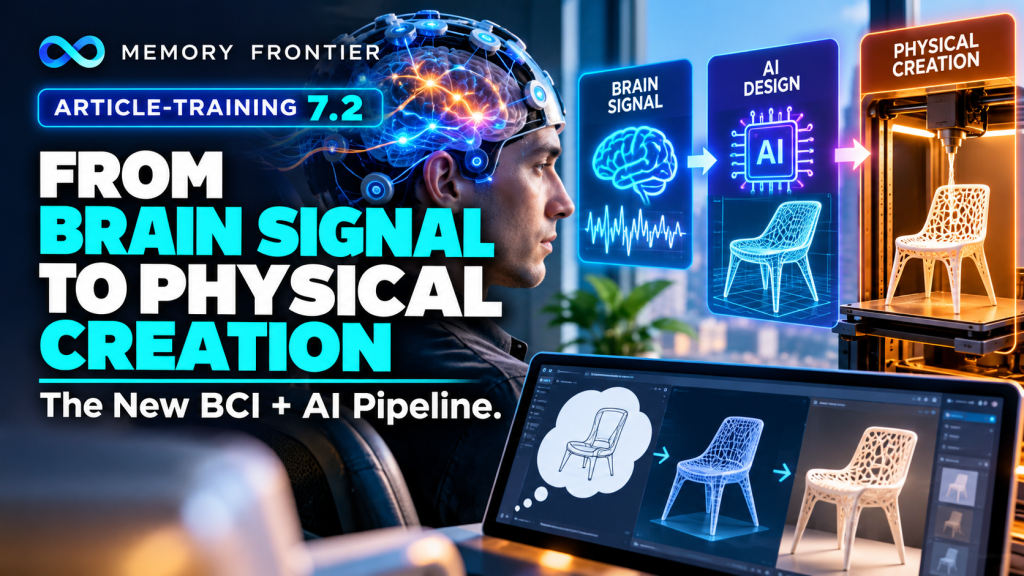
AI can then transform that signal into a richer digital representation — and that representation can potentially become a physical object.
A useful brain-computer interface does not need to reconstruct an entire thought.
BCIs can infer task-relevant patterns from neural activity and translate them into control signals such as selections, cursor movements, attempted speech features or other commands.
Neural Activity → Decoded Intent → Control Signal
Generative AI can expand a small human signal into a much richer representation.
A rough sketch, selected concept or short instruction does not have to contain every detail of the desired result.
A generative model can help elaborate that input into text, images, designs or three-dimensional digital assets.
This creates an important architectural possibility:
the BCI can carry relatively sparse intent while AI performs high-bandwidth representational expansion.
The breakthrough may come from connecting technologies rather than waiting for one perfect neural decoder.
Neural decoding can become one component inside a larger system containing visual feedback, generative models, conventional software and fabrication technologies.
Brain Signal → BCI → AI → Digital Design → Physical Output
The BCI does not have to transmit the entire creation.
It may only need to transmit
human intent —
while AI supplies
representational bandwidth.
AI can expand intent without replacing the person’s goals.
The user can initiate an objective, inspect generated alternatives, make selections and reject unwanted results.
The AI performs part of the transformation, while the human remains the source of preference and direction.
Intent → Generate → Inspect → Select → Refine
Once intent becomes a digital model, ordinary fabrication technologies can carry it into the physical world.
A 3D printer does not decode neural signals.
Instead, it receives a digital object produced downstream in the pipeline.
The BCI is the upstream human-control interface; AI helps transform the signal into a usable representation.
Human Intent → Neural Interface → AI Transformation → Fabrication
The strongest near-term opportunity is not science-fiction telepathy. It is restored agency.
For people with severe motor impairment, even a relatively low-bandwidth neural interface can become valuable when downstream AI can translate limited control into richer communication or creative output.
The meaningful question is therefore not whether a BCI can decode every detail of cognition.
It is whether the combined system can restore useful capabilities reliably enough to matter.
A spectacular demonstration is not the same as a dependable assistive technology.
Clinical usefulness requires stable signal acquisition, repeatable decoding, manageable calibration, safe hardware and an interface people can use consistently.
Demo → Reliability → Repeatability → Usability → Real-World Value
Low-bandwidth human intent may be enough when paired with high-bandwidth AI.
This is the deeper incubator-level thesis.
Future human-machine interfaces may not require the brain to communicate enormous amounts of information directly.
Instead, the human may provide sparse but meaningful intent while AI expands it — with the person retaining selection, correction and veto authority.
The interface between cognition and machines may become increasingly asymmetric.
Humans may not need to provide every pixel, word or geometric detail.
A relatively small signal expressing intention or preference could become enough for an AI system to construct much richer possibilities.
The emerging thesis is
low-bandwidth human intent + high-bandwidth AI expansion + human selection.
This is not unrestricted mind reading.
Current BCI systems decode specific neural signals within constrained tasks and experimental conditions.
AI can transform those decoded signals into richer outputs, but that does not mean the system can freely read arbitrary private thoughts or reconstruct the full contents of human consciousness.
Explore the BCI + AI creation pipeline in greater depth
The complete Article-Training provides a guided exploration through:
- 8 learning modules
- 24 interactive practice cases
- Neural signals versus complete thoughts
- AI as an intent amplifier
- Multimodal BCI + AI pipelines
- Human preference and veto authority
- Digital-to-physical creation
- Assistive neurotechnology
- Reliability and usability constraints
- Low-bandwidth intent + high-bandwidth AI
- English / Spanish learning experience
- Participation tracking
- Certificate of Participation
Controlled demonstrations support the feasibility of combining BCI control with AI-assisted digital creation workflows.
They do not establish unrestricted thought decoding, general-purpose brain-AI fusion or broad clinical effectiveness.
The important frontier signal is the architecture of the pipeline and its potential assistive value, while reliability, repeatability and clinical utility remain critical evaluation boundaries.
Continue with the complete learning experience
Explore the complete interactive learning experience, work through the 24 practice cases, and generate your Certificate of Participation.