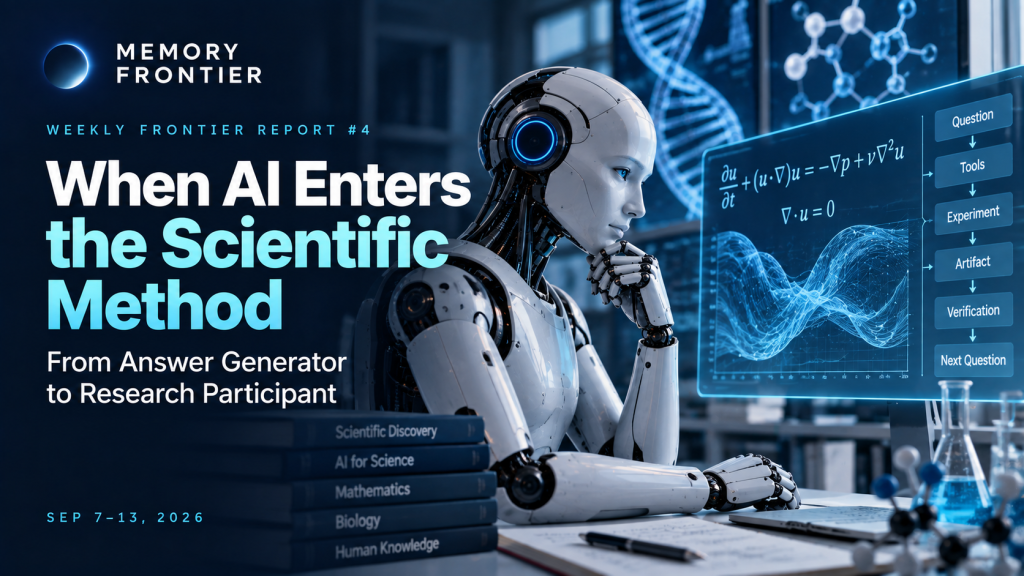
Artificial intelligence is beginning to participate in parts of the scientific process itself.
For years, the most visible role of AI in science was assisting researchers with literature review,
coding, analysis, writing, and explanation. Those functions remain useful. But a more consequential
frontier is emerging: AI systems that can participate in multi-step research workflows.
The important shift is not simply better answers. It is participation in the research loop.
A conventional AI interaction often begins with a question and ends with an answer.
Scientific work is different. Research requires a sequence of connected activities:
formulating questions, selecting tools, running calculations or experiments, producing artifacts,
inspecting results, verifying claims, and deciding what to investigate next.
Question → Tools → Experiment → Artifact → Verification → Next Question
A proposed Navier–Stokes result illustrates how far the workflow can extend.
On September 8, 2026, OpenAI published an AI-generated proposed solution to the
three-dimensional Navier–Stokes Millennium Prize problem, accompanied by a long technical
write-up and a formal Lean proof.
The scientifically responsible interpretation is not that the Millennium Prize problem should
automatically be considered solved. OpenAI itself describes the work as a proposed solution,
and independent expert review remains essential.
The important frontier signal is that an AI system participated in producing a highly structured
mathematical research artifact that can be inspected, formalized, and challenged by other researchers.
A machine-readable proof is stronger than a persuasive paragraph — but it is not the end of scientific judgment.
Formal systems such as Lean allow mathematical arguments to be represented in a way that software can
mechanically check against explicit rules. This creates a stronger verification layer than natural-language
reasoning alone.
Claim → Formalization → Machine Check → Expert Review → Scientific Acceptance
Formal verification can establish that a proof artifact follows its encoded logic. It does not automatically
settle every question about assumptions, interpretation, mathematical novelty, relevance, or external acceptance.
The scientific frontier is not simply
AI knowing more.
It is AI participating in longer, inspectable, verifiable research workflows.
Human researchers remain essential because scientific validity is larger than computation.
As AI systems perform more intermediate research tasks, human value increasingly concentrates around:
- Choosing consequential questions
- Defining assumptions
- Evaluating methodology
- Checking whether evidence supports the claim
- Interpreting results
- Identifying hidden limitations
- Comparing with prior scientific knowledge
- Reproducing or independently validating results
- Deciding whether a result changes scientific understanding
- Applying ethical and domain judgment
The boundary is shifting from helping with research to performing parts of research.
An AI research assistant may summarize papers, generate code, explain equations, or organize evidence.
A research participant can potentially connect several of those capabilities into a longer workflow.
The difference is architectural. The system does not merely produce one response. It can use the output of one
step as the input to another step, inspect what happened, and continue toward a research objective.
Research capability becomes more consequential as the loop becomes more complete.
Question → Plan → Tool Use → Experiment → Result → Artifact → Verify → Revise
A system that can complete only one step is useful. A system that can connect several steps begins to change
the economics, speed, and organization of research. But every additional autonomous step also increases the
importance of verification, reproducibility, and human oversight.
The unit of AI capability worth measuring may be getting larger.
For much of the generative-AI era, capability was judged one response at a time:
Can the model answer this question? Can it solve this coding problem? Can it explain this paper?
The emerging frontier asks a different question:
How much of a consequential scientific loop can the system reliably complete,
and where must human researchers remain inside that loop?
Explore AI participation in the scientific method in greater depth
The complete Article-Training provides a guided exploration through:
- Learning modules
- 24 interactive practice cases
- AI-assisted research scenarios
- Research-loop concepts
- Formal verification and evidence boundaries
- Critical-thinking exercises
- English / Spanish learning experience
- Participation tracking
- Research grounding
- Certificate of Participation
The September 2026 Navier–Stokes work is best understood as a proposed AI-generated research result,
not as automatic proof that the Millennium Prize problem is definitively settled. Formal Lean verification
provides a meaningful additional evidence layer, but independent mathematical review remains essential.
More broadly, AI participation in research workflows does not establish autonomous science, perfect reliability,
or the disappearance of human researchers. The frontier is the growing ability of AI systems to perform
increasingly connected parts of the research process while remaining subject to verification and expert judgment.
Continue with the complete learning experience
Explore the complete interactive learning experience, work through the 24 practice cases,
and generate your Certificate of Participation.