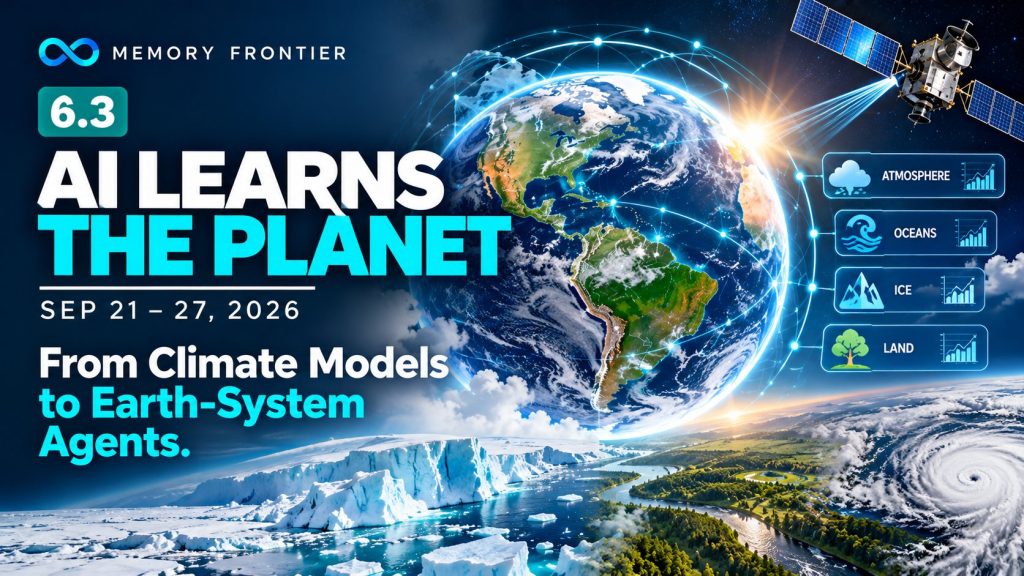
Artificial intelligence is moving beyond weather prediction toward a more ambitious scientific frontier: helping researchers simulate, interrogate and understand components of the Earth system.
Machine-learning emulators, differentiable models and agent-assisted scientific workflows are beginning to change how complex planetary processes can be explored.
The transition is from predicting the atmosphere toward building faster, more interactive Earth-system science.
AI weather forecasting demonstrated something important. Data-driven systems can reproduce parts of atmospheric evolution with remarkable computational efficiency.
But weather prediction is only one part of the Earth system. Climate research must also represent oceans, sea ice, land, atmosphere and the interactions among them across much longer timescales.
Weather → Climate → Coupled Earth Systems
Instead of recalculating every physical process from scratch, AI can learn to approximate important behavior of expensive scientific models.
These learned systems are often called emulators. A well-validated emulator can reproduce selected behavior of a computationally expensive physical model while requiring far less computation.
That can make large ensembles, sensitivity studies and rapid scenario exploration more practical—but speed does not remove the need for physical validation.
A fast Earth-system model is not useful if it quietly violates the physical budgets that make the system meaningful.
Conservation constraints can be essential. In sea-ice modeling, for example, a model that predicts plausible-looking patterns while gradually creating or destroying unrealistic amounts of ice would eventually drift into scientifically unusable states.
AI Speed + Physical Constraints + Validation
The emerging direction is therefore not simply replacing physics with AI. It is increasingly about combining learned approximation with physical structure.
The frontier is moving from
“Can AI predict the weather?”
toward
“Can AI help us interrogate the dynamics of the Earth system?”
A model that can expose how its outputs respond to changing inputs creates a new kind of scientific instrument.
Differentiable models provide gradients—information describing how model outputs change when parameters or inputs change.
Input Change → Model Response → Gradient → Optimization
Those gradients can support parameter calibration, sensitivity analysis, optimization and hybrid AI–physics workflows. Differentiability does not guarantee that a model is correct, but it can make the model easier to interrogate computationally.
AI agents may also change Earth science by helping scientists transform the software infrastructure underneath the models.
Many Earth-system models contain decades of scientific knowledge encoded in large legacy software systems designed for traditional supercomputers.
Agent-assisted coding workflows can help translate or reconstruct portions of that scientific software inside modern GPU-oriented frameworks.
But translation is not enough. Scientific equivalence must be tested systematically against established simulations and benchmarks.
Climate science asks AI to operate in conditions that may differ from the world represented in its training data.
A weather model can be evaluated on many examples drawn from familiar atmospheric conditions. Climate applications pose a harder question: how does the system behave when external forcing changes and the climate itself begins moving beyond the historical distribution?
Historical Climate → Changed Forcing → New Conditions → Generalization Test
Stable long-duration simulation and credible responses under changed conditions are therefore stronger tests than reproducing familiar short-term weather statistics.
Faster models could change the way scientists interact with planetary simulations.
Traditional climate simulations can be computationally expensive enough that researchers must carefully ration how many scenarios and ensemble members they run.
If validated learned components dramatically reduce that cost, researchers may be able to explore more scenarios, perturb more parameters and investigate uncertainty more interactively.
Faster Simulation → Larger Ensembles → More Scenarios → Better Exploration
A planetary model does not make a planetary decision.
Climate adaptation decisions depend on uncertainty, infrastructure, economics, local geography, social priorities and institutional capacity—not simply on a model output.
Model → Scenarios → Uncertainty → Human Decision
AI can potentially make Earth-system information faster and more accessible. It does not eliminate the human responsibility of deciding what should be done with that information.
The longer-term possibility is not merely a faster climate model. It is an interactive scientific environment around the model.
Imagine a researcher asking an agent to investigate a climate mechanism, identify the relevant model components, run controlled scenarios, compare outcomes, quantify uncertainty and return the evidence for inspection.
Question → Model → Scenario → Simulation → Evidence → New Question
That would not mean AI “controls the planet.” It would mean that scientists gain a more interactive computational interface for interrogating planetary models.
Earth-system modeling may be moving from expensive batch computation toward interactive, differentiable and agent-assisted science.
The transition is still early. Learned components must demonstrate physical consistency, long-term stability, generalization and scientific reliability before they can support high-consequence applications.
But the emerging thesis is significant:
AI emulation + physical constraints + differentiable models + agentic scientific workflows.
Together, those capabilities could change not only how quickly Earth systems are simulated, but how scientists interact with the models themselves.
Explore the AI Earth-system frontier in greater depth
The complete Article-Training provides a guided exploration through:
- 8 learning modules
- 24 interactive practice cases
- Weather AI versus climate AI
- Machine-learning emulators
- Physical conservation constraints
- Differentiable Earth-system models
- Agent-assisted scientific coding
- Climate generalization challenges
- Scenario exploration and decision support
- The emerging Earth-system agent
- English / Spanish learning experience
- Participation tracking
- Certificate of Participation
Current evidence supports fast learned components, physically informed emulators, differentiable modeling workflows and AI-assisted modernization of scientific software. It does not demonstrate an AI system that comprehensively understands or independently models every coupled process of the Earth. Long-term stability, physical consistency, generalization, uncertainty and validation remain central scientific requirements.
Continue with the complete learning experience
Explore the complete interactive learning experience, work through the 24 practice cases, and generate your Certificate of Participation.