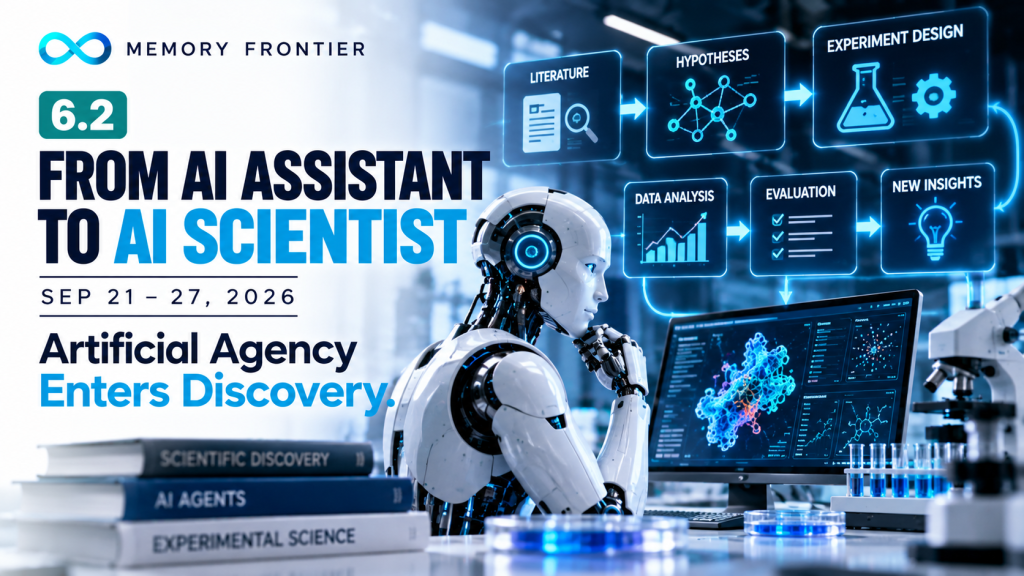
AI is beginning to move from answering scientific questions toward participating in parts of the scientific process itself.
AI co-scientist systems can increasingly decompose research questions, search literature, compare hypotheses, analyze data and coordinate multi-step workflows.
The frontier signal is artificial agency entering the research loop.
The important transition is not simply that AI gives scientists better answers. It can now participate in multi-step research workflows.
A conventional AI assistant responds to a request. An agentic research system can break a scientific objective into smaller tasks, assign specialized agents, inspect intermediate results and determine what should happen next.
Question → Decompose → Investigate → Compare → Refine
Instead of producing one answer, AI systems can generate competing scientific possibilities and interrogate them.
Co-scientist systems can search papers, generate candidate explanations, compare alternatives, critique weaknesses and refine hypotheses as additional evidence enters the workflow.
That does not turn a plausible hypothesis into a discovery. A hypothesis remains a proposition until it survives appropriate empirical testing and scientific scrutiny.
Scientific reasoning can be distributed across specialized artificial agents.
One agent might search literature. Another can analyze data. Another may challenge a hypothesis. Another can synthesize competing interpretations.
The system then coordinates those outputs around a shared research objective.
Search → Analyze → Critique → Synthesize → Iterate
The value is not that multiple agents automatically produce truth. The value is that complex intellectual work can be decomposed, explored in parallel and repeatedly checked.
The transition is from
“AI, answer my scientific question”
toward
“AI, help navigate the research process.”
AI agents can search and synthesize scientific literature at a scale difficult for a single researcher to match manually.
Scientific knowledge is expanding across millions of papers, datasets and specialized subfields. Agent teams can search, organize and cross-reference portions of that evidence much faster than a person reading sequentially.
But faster synthesis does not eliminate the source problem. Retrieval quality, missing evidence, misinterpretation and weak source selection can propagate through an automated research workflow.
Artificial agency becomes more consequential when computational reasoning connects back to empirical evidence.
Some research systems can propose experiments, analyze returned results and use those observations to refine subsequent hypotheses.
This begins to connect artificial reasoning with the experimental cycle rather than leaving AI entirely inside a conversational interface.
Hypothesis → Experiment → Evidence → Evaluation → Revised Hypothesis
Physical execution remains bounded or human-mediated in many systems. The important signal is the growing integration between computational research agents and empirical validation.
Scientific usefulness does not require us to assume human-like scientific understanding.
An AI system can be useful at literature search, coding, pattern recognition, hypothesis ranking or experimental planning without demonstrating human-like understanding, consciousness or independent scientific intent.
Claims should therefore remain tied to measurable capabilities and validated research tasks rather than anthropomorphic labels.
When generating hypotheses becomes inexpensive, deciding which hypotheses deserve attention becomes more valuable.
A research system capable of generating hundreds or thousands of plausible ideas creates a new problem: evaluation.
Scientists still need to determine which questions matter, which evidence is credible and which experiments justify scarce time and resources.
More Generation → More Evaluation → Greater Value of Judgment
The scarce resource may increasingly become scientific judgment rather than the ability to generate another candidate explanation.
The more autonomous the research workflow becomes, the more important auditability becomes.
Scientific agents need inspectable evidence trails: sources, code, intermediate artifacts where appropriate, experiment logs, assumptions and explicit uncertainty.
Source → Analysis → Decision → Experiment → Result → Verification
Agent confidence is not scientific validation. Independent verification and reproducibility remain stronger than the apparent certainty of an AI-generated conclusion.
Artificial agency can automate pieces of research without automating the meaning of research.
Humans remain responsible for determining meaningful objectives, evaluating scientific significance, defining acceptable risk, interpreting ambiguous evidence and deciding when results deserve further investigation.
Human: Purpose + Judgment + Accountability
AI: Search + Analysis + Generation + Coordination
The frontier is therefore not simply replacement. It is a redistribution of work across the scientific method.
AI is moving from a passive analytical layer toward an active orchestration layer inside research.
The key question is not whether an AI system deserves to be called a “real scientist.”
A more useful question is which parts of the scientific loop can be delegated, accelerated and rigorously validated.
The emerging thesis is
artificial agency + scientific tools + empirical evidence + human judgment.
As those layers become more tightly connected, AI may increasingly participate in how scientific discovery is organized.
Explore the AI co-scientist frontier in greater depth
The complete Article-Training provides a guided exploration through:
- 8 learning modules
- 24 interactive practice cases
- AI assistants versus scientific agents
- Multi-agent research workflows
- Hypothesis generation and critique
- AI-assisted literature synthesis
- Experiment design and empirical validation
- Scientific judgment and human oversight
- Auditability and reproducibility
- English / Spanish learning experience
- Participation tracking
- Certificate of Participation
Current evidence demonstrates multi-step agentic research workflows in bounded scientific settings. It does not establish a universal, independent AI scientist capable of reliably conducting every stage of research across disciplines. Source quality, experimental validation, reproducibility, generalization and human oversight remain central limitations.
Continue with the complete learning experience
Explore the complete interactive learning experience, work through the 24 practice cases, and generate your Certificate of Participation.