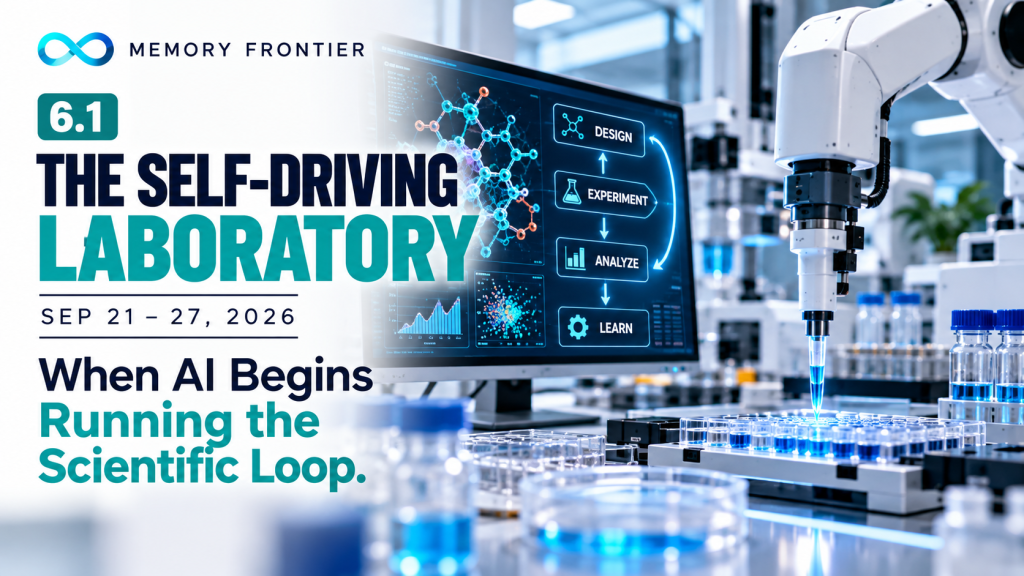
The laboratory is beginning to close its own scientific loop: choose an experiment, execute it, measure the result, learn from it, and decide what to test next.
Self-driving laboratories combine AI decision-making, automated instruments and robotics.
The signal is closed-loop experimentation:
experimental evidence can now influence the next experiment with limited human intervention.
The important change is not simply that machines perform experiments. It is that results can change what the laboratory does next.
Traditional laboratory automation follows a predefined script. A self-driving laboratory adds a decision layer: measurements update a model, and that model helps select the next experiment.
Design → Make → Test → Analyze → Learn → Redesign
Experimental evidence becomes an input to the next decision.
A common architecture links experimental design, robotic execution, characterization, analysis and selection of the next candidate. Each stage must exchange reliable, machine-readable information.
This is what separates a closed-loop system from a machine that simply repeats the same automated procedure faster.
AI can help choose which experiment is most valuable to run next.
Optimization and active-learning methods can prioritize experiments expected to be informative or promising, reducing brute-force search across very large design spaces.
Observe → Update Model → Select Candidate → Experiment → Observe Again
Optimization does not guarantee discovery or truth. It changes the economics of search by helping allocate experimental effort more intelligently.
The laboratory is shifting from
“automate this procedure”
toward
“use the evidence to decide what we should test next.”
Robotics gives the computational loop a physical interface.
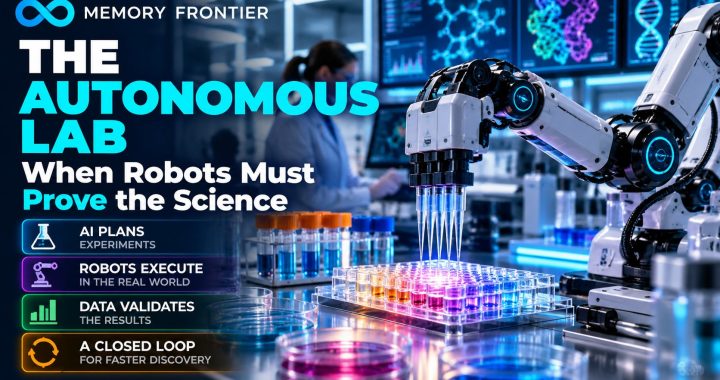
Robots, pumps, reactors and automated characterization tools translate a computational choice into a physical experiment. Sensors then return measurements to the analytical layer.
Reproducibility remains essential: speed has little scientific value if researchers cannot determine whether a result came from the material, the procedure, an instrument condition or an automation error.
An autonomous experiment is only as trustworthy as its experimental record.
Materials, settings, calibrations, software versions, measurements and machine decisions need to remain reconstructable. As more steps become automatic, complete experimental provenance becomes more—not less—important.
Experiment → Data → Metadata → Decision → Audit Trail
The scientific asset is therefore not only the final result. It is the traceable chain connecting the question to the result.
A laboratory that masters one workflow is not automatically a general autonomous scientist.
A self-driving platform can perform extremely well inside a bounded chemistry or materials workflow while still requiring substantial engineering to transfer across instruments, protocols, materials and scientific domains.
Scaling throughput and generalizing scientific capability are different problems. The strongest current evidence supports domain-specific autonomous experimentation—not universal autonomous science.
As machines execute more of the loop, human judgment becomes more concentrated around objectives, boundaries and meaning.
Researchers still determine which questions matter, what constraints are acceptable, how anomalies should be interpreted, when a result deserves independent verification and whether a discovery is scientifically consequential.
Human: Question + Boundaries + Judgment
Machine: Search + Execution + Measurement + Iteration
Autonomy changes where human expertise is applied; it does not eliminate scientific accountability.
Portions of experimental science are becoming programmable feedback systems.
Hypothesis → Experiment → Evidence → Model Update → Next Experiment
Software proposes, hardware executes, sensors observe and algorithms update the next move. The emerging strategic capability is the trustworthy integration of those pieces into a reproducible loop.
Scientific automation is moving from executing instructions toward adaptive experimentation.
If the loop is reliable, researchers can explore larger design spaces, run more systematic experiments and spend less time manually coordinating repetitive execution.
The emerging thesis is
AI decision-making + robotic execution + experimental evidence + reproducible provenance.
The frontier is not a robot replacing science. It is a scientific loop becoming increasingly programmable.
Explore the self-driving laboratory frontier in greater depth
The complete Article-Training provides a guided exploration through:
- 8 learning modules
- 24 interactive practice cases
- Automation versus autonomy
- Closed-loop experimentation
- AI-driven experiment selection
- Robotics and physical execution
- Experimental provenance
- Scaling and generalization
- Human scientific oversight
- English / Spanish learning experience
- Participation tracking
- Certificate of Participation
Current self-driving laboratories demonstrate real closed-loop experimentation in bounded scientific domains. They should not be interpreted as proof of a general autonomous scientist capable of independently operating across all disciplines. Scalability, transfer across workflows, robust validation and complete experimental provenance remain important challenges.
Continue with the complete learning experience
Explore the complete interactive learning experience, work through the 24 practice cases, and generate your Certificate of Participation.