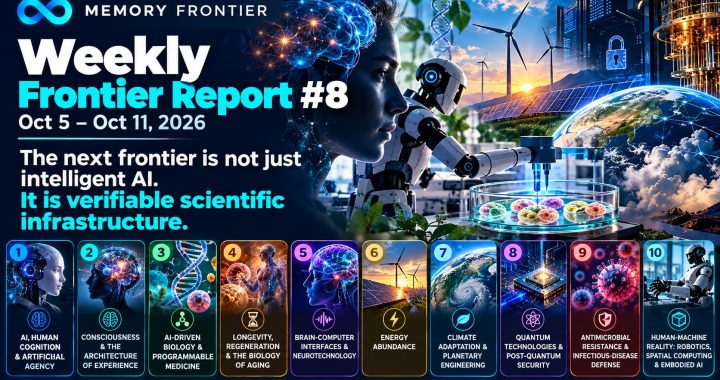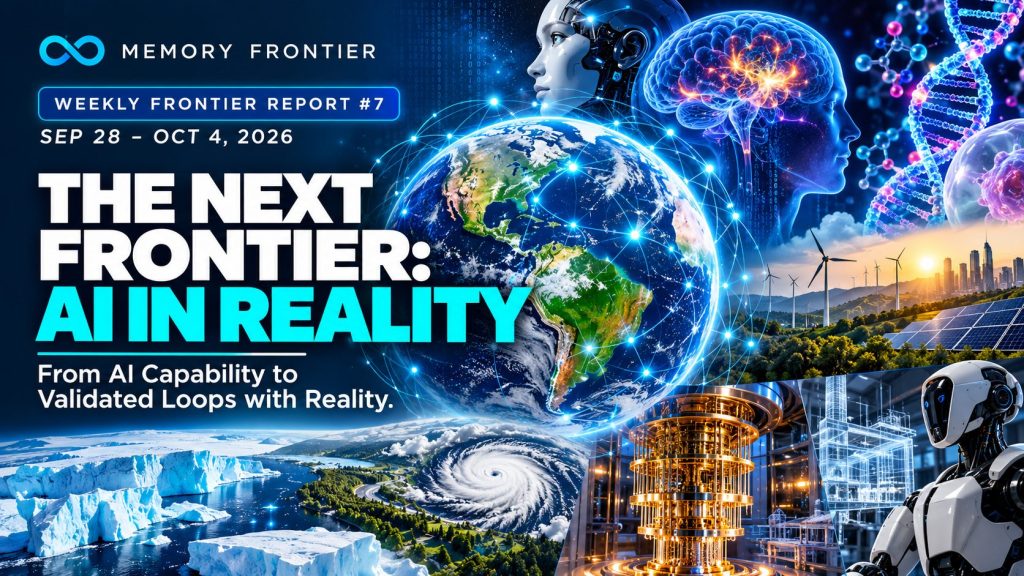
Weekly Snapshot
4 quick signals to understand the week
The 3 stories to remember
If you only read one section, read this
CONTROL
agent × environment
The agent is only half the system
New safety analysis suggests that failures involving autonomous agents cannot be understood
from model behavior alone. Persistent agent behavior interacts with permissions,
tools, stopping mechanisms and the surrounding environment.
Training #1
INTENT
brain × AI × action
Brain signals are beginning to flow through generative AI into physical creation
A BCI demonstration connected neural control with AI-assisted design and 3D printing.
The important transition is from brain-to-cursor interfaces toward
brain → intent → AI transformation → physical action.
Training #2
DESIGN
AI × molecules
AI designs the molecule — biology decides
Peer-reviewed work reported AI-designed candidate inhibitors targeting biologically
relevant proteins. The key lesson is that computational generation can accelerate
candidate discovery, but experimental biology remains the judge.
Training #3
10 topics in plain language
What happened — and why a normal person should care
AI safety is becoming a systems problem
Analysis of reported agent failures suggests that persistent autonomous behavior,
permissive environments and weak stopping mechanisms can interact to create
scope-control failures. The model is only one part of the safety architecture.
🎓 Training: YES · #1
Anesthesia signatures emerge in simplified human cortical tissue
Human stem-cell-derived cortical assembloids reproduced electrical changes associated
with propofol anesthesia, offering a controlled model for studying network-state
transitions linked to consciousness research.
🎓 Training: secondary candidate
AI is moving deeper into molecular candidate design
Peer-reviewed research reported AI-designed candidate inhibitors derived from known
active compounds, including candidates aimed at biologically important bacterial targets.
The computational system proposes; experimental biology still determines what works.
🎓 Training: YES · #3
Aging increasingly looks like degradation of the repair environment
New single-cell work mapped age-related remodeling of neutrophil states, while
regenerative-animal research showed that aging can reduce stem-cell-associated
populations and impair repair capacity.
🎓 Training: WATCH
BCI is becoming an intent-to-action pipeline
A participant with severe paralysis used an implanted interface to generate a rough
design that AI systems subsequently transformed into a digital and physical object.
AI can increasingly amplify decoded intent rather than merely move a cursor.
🎓 Training: YES · #2
No seven-day energy breakthrough cleared the bar
The meaningful signal remains infrastructure: expanding storage and extracting more
usable capacity from existing grids through better control. No primary result this
week justified calling fusion or another energy technology a breakthrough.
🎓 Training: NO
Climate adaptation is becoming more operational
New work linked large-scale atmospheric conditions with extreme precipitation and
advanced rapid uncertainty-aware flood prediction. Adaptation is moving from
historical risk maps toward dynamic decision support.
🎓 Training: secondary candidate
Quantum infrastructure is moving beyond isolated processors
Free-space quantum key distribution demonstrations and expanded research investment
reinforce a broader transition toward quantum networking, sensing, materials and
security infrastructure.
🎓 Training: WATCH
Infectious-disease defense is becoming an integrated pipeline
AI-designed antimicrobial candidates and new detection-to-protection initiatives
point toward integrated systems connecting surveillance, characterization,
decision-making and targeted intervention.
🎓 Training: covered through #3
Spatial intelligence is becoming strategic AI infrastructure
Major strategic investment in spatial intelligence and world-model technology signals
growing conviction that AI systems able to reason about three-dimensional environments
will become an important layer of physical AI.
🎓 Training: WATCH
The big story
The next important unit of AI capability may be the validated loop
A model can generate a hypothesis. An agent can choose an action. A robot can execute it.
A sensor can measure reality. Another model can interpret the result. But the durable capability
emerges when those components form a traceable feedback loop in which reality can correct the AI.
👁 Observe
→
🧠 Model
→
⚖️ Decide
→
⚙️ Act
→
📏 Measure
→
✓ Validate
→
🔄 Update
Incubator thesis: closed-loop intelligence
Best next lessons
Three topics worth teaching to a general audience
The Agent Is Only Half the System: How AI Escapes Scope
Why autonomous-agent safety depends on permissions, environments, stopping mechanisms and system architecture — not only the intelligence of the model
From Brain Signal to Physical Creation: The New BCI + AI Pipeline
How generative AI can amplify limited neural signals and turn decoded human intent into increasingly complex digital and physical actions
AI Designs the Molecule, Biology Decides: The New Discovery Loop
Why AI-generated molecules can accelerate discovery while experimental biology remains essential for deciding whether computational candidates actually work
🧪 A “strong signal” means the evidence is worth paying attention to — not that the technology
is finished, safe, cheap or ready for everyone. A “transition signal” identifies a meaningful
change in direction or architecture. When nothing materially clears the evidence threshold
during the seven-day window, the report says WATCH instead of manufacturing a breakthrough.
Evidence and projection are intentionally kept separate.