What changed this week?
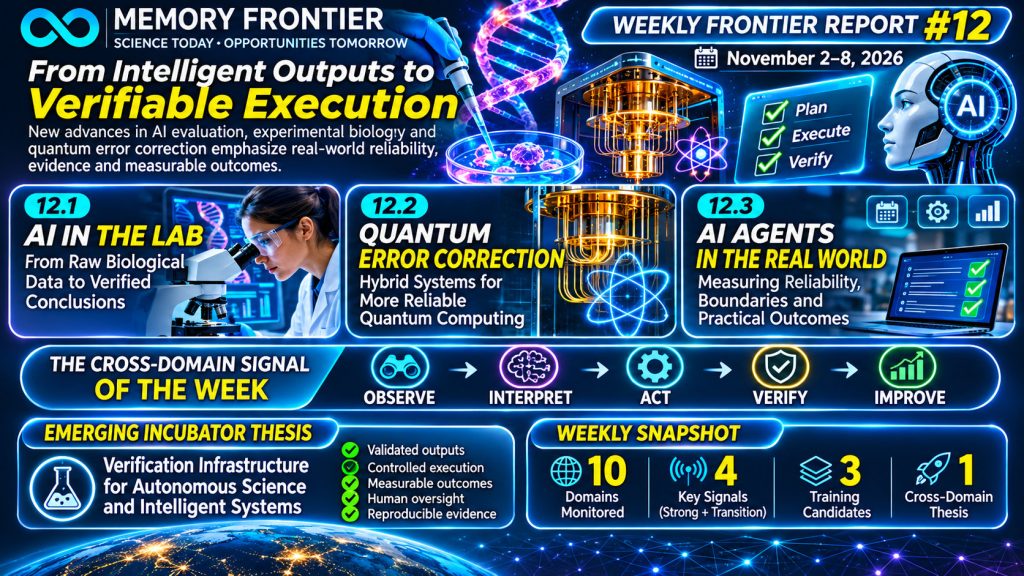
From intelligent outputs → verifiable execution.
Agent reliability, biological evidence interpretation and hybrid quantum error correction reveal the growing importance of verification.
📊 Weekly snapshot
If you read only one section, read this
When AI Reads the Lab
Raw laboratory observations, experimental controls and reproducible scientific conclusions.
Quantum Error Correction Meets Supercomputing
Hybrid quantum-classical systems explore error diagnostics and correction without proving fault tolerance.
Beyond AI Benchmarks
Evaluating real-world agent workflows, authorization boundaries and measurable task outcomes.
What happened — why it matters
AI, Human Cognition & Artificial Agency
LifeVal and GPT-6 Cyber focus attention on real task performance
What Happened: OpenAI introduced LifeVal on November 2, with tasks grounded in everyday needs, and reported GPT-6 Cyber evaluation results on November 5. These are developer-reported evaluations.
Why It Matters: Agent quality is increasingly assessed by task completion, authorized behavior, recovery and operational reliability.
Domain-Incubation Impact: Prototype an agent-evaluation harness with permission checks, exception handling, human approvals and auditable outcomes.
Hype Check: Reported benchmark improvements do not demonstrate universal reliability or general autonomous intelligence.
Training-Article: YES — TOP 3: Beyond AI Benchmarks
Sources: OpenAI LifeVal (Nov 2); OpenAI GPT-6 Cyber (Nov 5).
Consciousness & the Architecture of Experience
No verified seven-day breakthrough in subjective experience
What Happened: An interdisciplinary workshop discussed internal embodiment and multimodal AI models, but did not establish subjective machine experience.
Why It Matters: Representations of internal states are distinct from the existence of consciousness.
Domain-Incubation Impact: Track preregistered causal tests and falsifiable comparisons between theories.
Hype Check: Internal-state modeling is not proof of consciousness.
Training-Article: NO — monitor
Sources: Interdisciplinary workshop agenda (Nov 7); no qualifying primary experimental breakthrough.
AI-Driven Biology & Programmable Medicine
BioBasicsBench evaluates AI on raw wet-lab evidence
What Happened: On November 6, OpenAI and Ligo introduced a 100-task benchmark across assays, microscopy, cytometry and molecular methods. They reported GPT-6 Astra at 66.7% and GPT-5.6 Sol at 43.8% of available credit.
Why It Matters: Scientific usefulness requires interpreting noisy observations and recognizing unsupported conclusions.
Domain-Incubation Impact: Develop reproducible laboratory-data QA pipelines with control checks and explicit uncertainty.
Hype Check: A benchmark score is not clinical validation, independent scientific discovery or proof of autonomous lab competence.
Training-Article: YES — TOP 1: When AI Reads the Lab
Sources: OpenAI and Ligo, BioBasicsBench (Nov 6); developer-reported evaluation.
Longevity, Regeneration & the Biology of Aging
No qualifying seven-day breakthrough confirmed
What Happened: No sufficiently substantiated new result in human longevity or regeneration met this week’s editorial threshold.
Why It Matters: Animal and molecular findings must be separated from demonstrated clinical benefit.
Domain-Incubation Impact: Monitor independently replicated biomarkers, tissue-specific interventions and prospective human outcomes.
Hype Check: No claim of rejuvenation or extended human lifespan is warranted this week.
Training-Article: NO — hold
Sources: No qualifying primary source verified for Nov 2–8.
Brain-Computer Interfaces & Neurotechnology
No new verified clinical BCI milestone
What Happened: No qualifying seven-day milestone in long-term device safety or functional clinical improvement was verified.
Why It Matters: Clinical utility depends on stable signals, patient-relevant function and safety over time.
Domain-Incubation Impact: Track longitudinal stability, closed-loop control and reproducible outcomes.
Hype Check: Do not repackage earlier animal-model results as a new human breakthrough.
Training-Article: NO — hold
Sources: No qualifying primary source verified for Nov 2–8.
Energy Abundance
No qualifying seven-day breakthrough confirmed
What Happened: No independently verified new fusion, storage or power-generation milestone met this week’s threshold.
Why It Matters: Energy abundance claims require delivered cost, reliability, scalability and system-level measurements.
Domain-Incubation Impact: Track grid integration, storage economics, sustained fusion performance and operating costs.
Hype Check: A financing or capacity announcement is not an energy-physics breakthrough.
Training-Article: NO — monitor
Sources: No qualifying primary source verified for Nov 2–8.
Climate Adaptation & Planetary Engineering
No qualifying seven-day breakthrough confirmed
What Happened: No sufficiently substantiated new climate-intervention or adaptation result met the reporting threshold.
Why It Matters: Adaptation claims need measured outcomes, external validity and transparent costs.
Domain-Incubation Impact: Monitor municipal heat-risk, resilience measurement and verified intervention outcomes.
Hype Check: Model projections do not establish successful planetary engineering.
Training-Article: NO — hold
Sources: No qualifying primary source verified for Nov 2–8.
Quantum Technologies & Post-Quantum Security
IBM, AMD and Oak Ridge launch hybrid quantum-error-correction research
What Happened: On November 5, IBM, AMD and Oak Ridge National Laboratory announced a research platform linking quantum hardware and classical supercomputing to study error detection and correction.
Why It Matters: Reliable quantum systems require integrated control, diagnostics and classical computing.
Domain-Incubation Impact: Explore simulated error-correction pipelines, logical error metrics and orchestration overhead.
Hype Check: A research platform is not a commercially useful fault-tolerant quantum computer and does not imply encryption has been broken.
Training-Article: YES — TOP 2: Quantum Error Correction Meets Supercomputing
Sources: IBM / AMD / Oak Ridge National Laboratory announcement (Nov 5).
Antimicrobial Resistance & Next-Generation Infectious-Disease Defense
No qualifying new seven-day breakthrough
What Happened: The October 2026 CDC resistance assessment remains relevant background, but falls outside this week’s publication window.
Why It Matters: Surveillance, infection prevention and stewardship remain essential despite the absence of a new headline.
Domain-Incubation Impact: Maintain methods-aware pathogen dashboards and evidence provenance.
Hype Check: Do not interpret revised estimates as direct year-over-year increases or repeat Week #11 as new news.
Training-Article: NO — already covered in Week #11
Sources: CDC October 2026 assessment: prior-period context only.
Human-Machine Reality: Robotics, Spatial Computing & Embodied AI
Efficient embodied models move toward practical deployment constraints
What Happened: CoRL 2026 workshop updates on November 5–7 emphasized latency, model size, power requirements and safe control for physical robotics.
Why It Matters: Physical deployment is limited by inference speed, energy, reliability and safety—not model scores alone.
Domain-Incubation Impact: Track edge inference, quantization, safe recovery and cost per successful physical task.
Hype Check: A workshop program is not a validated robotics performance breakthrough.
Training-Article: NO — promising future candidate
Sources: CoRL 2026 workshop program updates (Nov 5–7).
From Intelligent Outputs to Verifiable Execution
Agent evaluations, wet-laboratory interpretation, hybrid quantum error correction and embodied robotics converge on one engineering priority: measurable performance under real constraints. These remain separate research programs, not one integrated scientific system.
Verification Infrastructure for Autonomous Science and Intelligent Systems
An incubator-level hypothesis: develop reusable tools that preserve evidence provenance, detect errors, enforce authorization boundaries, measure uncertainty and independently verify outcomes across intelligent workflows. Prototype with reproducible synthetic data before investing in additional infrastructure. Commercial demand and cross-domain transfer remain unproven.
🧪 Evidence discipline
Signal labels describe editorial relevance, not deployment readiness. Developer-reported benchmarks require independent replication; quantum research infrastructure is not fault-tolerant computation; robotics workshop agendas are not experimental validation. WATCH domains are intentionally not filled with older announcements.
Research window: November 2–8, 2026. Check original study methods and dates before medical, engineering, investment or policy use.