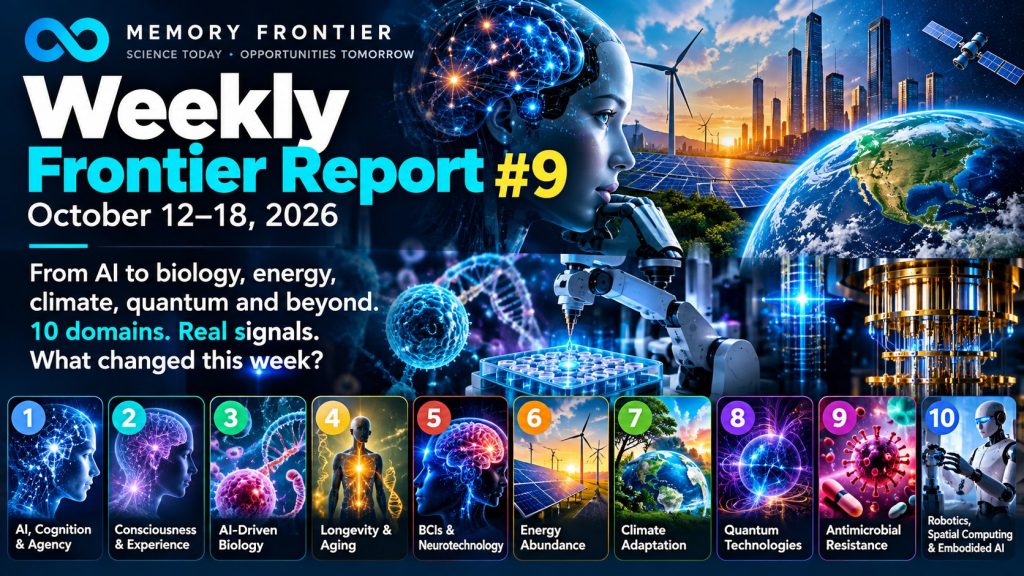
What changed this week?
From prediction → experimentally verified discovery.
Quantum circuit design, autonomous chemistry and precision immunology converge around a question: can AI generate results that reality can verify?
📊 Weekly snapshot
If you read only one section, read this
The Self-Driving Laboratory
3,000+ decisions in 30 days: autonomy becomes a measurable experimental workflow.
AI Designs Quantum Circuits
Algorithmic gate reduction is promising—but hardware advantage remains unproven.
Programmable Immunology
Cell-selective IL-10 engineering advances, with human efficacy still untested.
What happened — why it matters
1. AI, Human Cognition & Artificial Agency
Oct. 15: Mistral introduced Timestral, a 5M–209M-parameter time-series model family that reports strong zero-shot probabilistic forecasting benchmarks and CPU inference. Oct. 16: Anthropic published a US-adult versus frontier-lab-staff survey showing a wide expectations and productivity gap. Oct. 12: its red team demonstrated partial components of model-driven replication on low-cost devices in controlled tests.
Why it matters: The frontier is diversifying beyond chat: specialized numerical models, measurable workplace adoption, and autonomy-related security research now matter as much as leaderboard position.
Domain-incubation impact: High: incubate a measurable “forecast → validate → decide” workflow; benchmark Timestral against Prophet and conventional baselines on held-out operational data.
Training-Article: YES — “Beyond the Chatbot: Forecasting Agents with Measurable Outcomes.”
Hype check: Timestral’s rankings are vendor-reported, not proof of superiority on local data. Anthropic’s replication experiment simplified access conditions; it does not show a self-spreading wild AI worm.
Sources: Mistral / Timestral · Oct 15 · Anthropic / expectations · Oct 16 · Anthropic / replication · Oct 12
2. Consciousness & the Architecture of Experience
No new original study within Oct. 12–18 met the threshold for a decisive consciousness breakthrough. An Oct. 15 Nature Biomedical Engineering research highlight discussed previously published psychedelic neuroimaging work, including a 62-person multimodal dataset; the highlight is not a new experiment.
Why it matters: The active research direction remains mapping brain dynamics, context and subjective reports together, without claiming a solved theory of experience.
Domain-incubation impact: Maintain the existing research watchlist; no new incubation milestone this week.
Training-Article: NOT THIS WEEK — wait for new primary results.
Hype check: Neural correlates of an altered state are not an explanation of consciousness itself.
3. AI-Driven Biology & Programmable Medicine
Oct. 14: a Nature paper engineered a four-part nanobody-based IL-10 receptor agonist that preferentially suppresses myeloid inflammation without the T-cell stimulation associated with native IL-10. Evidence spans cellular work, humanized mice and non-human primates; primate effects persisted for up to 30 days. A separate Nature study used AI to quantify brown-fat activity in approximately 8,700 people.
Why it matters: Precision therapeutics increasingly engineer receptor geometry and cell specificity, while AI helps convert large clinical archives into testable biological hypotheses.
Domain-incubation impact: Very high: track “design → cell-selective validation → animal safety → human trials”; separate discovery tools from approved therapies.
Training-Article: YES — “Programmable Immunology: Receptor Geometry as a Drug.”
Hype check: No clinical efficacy in humans has been demonstrated for the engineered IL-10 agonist; the brown-fat work is mainly observational.
Sources: Nature / selective IL-10 · Oct 14 · Nature / brown fat · Oct 14
4. Longevity, Regeneration & the Biology of Aging
Oct. 14: Nature reported AI-enabled clinical phenotyping of brown adipose tissue in a cohort of 101,243 cancer-center patients; greater measured activity correlated with more favorable cardiometabolic markers. Oct. 12: a cross-sectional Scientific Reports study associated blood biomarkers with MRI-estimated brain aging. Oct. 15: npj Aging proposed a macrophage mitochondrial workload–recovery framework for age-associated heart failure.
Why it matters: The near-term frontier is better phenotyping and mechanistic targeting of age-related dysfunction—not proven age reversal.
Domain-incubation impact: Medium-high: invest in biomarker validation and causal follow-up; demand longitudinal replication and clinically meaningful endpoints.
Training-Article: YES, secondary — “Brown Fat, AI and the Difference Between Biomarkers and Rejuvenation.”
Hype check: Associations do not establish that increasing brown fat prolongs lifespan. The macrophage framework is a hypothesis-generating article, not a completed therapy trial.
Sources: Nature / brown fat · Oct 14 · Scientific Reports / brain age · Oct 12 · npj Aging / macrophages · Oct 15
5. Brain-Computer Interfaces & Neurotechnology
Oct. 13: Science Corporation publicly reported the first use of its PRIMA retinal implant in a person with Stargardt disease. Importantly, the surgery actually occurred in May 2026; the new event was disclosure of early rehabilitation observations. The company says the patient identified a letter and then a word during initial sessions.
Why it matters: Neurotechnology is expanding from general “brain control” narratives to narrowly defined sensory-restoration indications with observable functional outcomes.
Domain-incubation impact: Medium: track device safety, visual acuity, functional reading and independent trial results before scale-up assumptions.
Training-Article: LATER — “Retinal Prostheses Are Neurointerfaces, Not Mind Reading.”
Hype check: Single-patient, company-reported early observations; not restored normal vision or a new seven-day implantation.
6. Energy Abundance
Oct. 14: a Nature study combined machine-learning molecular simulations, nuclear magnetic resonance and electrochemical evidence to identify multi-lithium-ion clusters in common battery electrolytes. These structures may help explain the formation of the protective electrode interface and guide more rational electrolyte design.
Why it matters: A mechanistic advance at the electrolyte level can improve future battery chemistry without requiring a new battery architecture.
Domain-incubation impact: Medium-high: track experimental replication, cycle life, cost, safety and manufacturability; treat efficiency gains as future engineering targets.
Training-Article: YES — “The Invisible Clusters Inside Lithium-Ion Batteries.”
Hype check: The paper does not announce a commercial cell with longer life or lower price. The widely circulated concrete thermal battery story was posted by Lehigh on Oct. 8, outside this seven-day window.
Sources: Nature / Li-ion clusters · Oct 14 · Lehigh / earlier thermal battery · Oct 8
7. Climate Adaptation & Planetary Engineering
Oct. 14: Nature Communications analyzed more than 2,500 connected drought–heatwave events, showing that compound extremes can migrate across regions rather than remain static. Oct. 16: another modeling paper found that temporary carbon storage can reduce some slow climate-system changes beyond the storage period, especially when paired with strong emissions cuts.
Why it matters: Adaptation maps must represent moving compound hazards; carbon accounting should distinguish storage duration, avoided warming and long-lived climate responses.
Domain-incubation impact: Very high: build decision tools for agriculture, water and infrastructure using migrating risk corridors and explicit uncertainty.
Training-Article: YES — “When Heatwaves and Droughts Move Together.”
Hype check: These are analysis and model results, not proof of a new geoengineering deployment. Temporary carbon storage does not replace permanent emissions reductions.
Sources: Nature Communications / compound extremes · Oct 14 · Nature Communications / temporary carbon · Oct 16
8. Quantum Technologies & Post-Quantum Security
Oct. 16: Anthropic reported an AI-assisted, evaluator-checked search over eight quantum-circuit tasks, with designs improving qubit/gate resource trade-offs; one decoder used about 12 times fewer gates than a published comparison. Oct. 12: a Nature Communications paper proposed a continuous-time noise-mitigation protocol for analogue quantum simulation.
Why it matters: Algorithm design can reduce the hardware burden of future quantum systems; noise mitigation addresses a different bottleneck. AI becomes a tool for discovering better computation, not only executing it.
Domain-incubation impact: Very high: track formal verification, independent reproduction, hardware demonstrations and PQC migration separately.
Training-Article: YES — “AI Designs Quantum Circuits: Why Fewer Gates Matter.”
Hype check: Anthropic’s study is a company report with a linked preprint, not a peer-reviewed demonstration of quantum advantage. No new RSA-breaking quantum machine or new PQC standard was verified this week.
Sources: Anthropic / circuit optimization · Oct 16 · Nature Communications / noise · Oct 12
9. Antimicrobial Resistance & Next-Generation Infectious-Disease Defense
No well-substantiated new antimicrobial-resistance treatment breakthrough was identified for Oct. 12–18. A notable Oxford study on time-resolved penicillin biosynthesis was publicized Oct. 8–9, outside the window. WHO participated in an Oct. 14–17 STI congress, but conference participation alone is not a scientific breakthrough.
Why it matters: The need for rapid diagnostics, surveillance, new antibiotics and phage research remains urgent; weekly news volume should not be confused with evidence.
Domain-incubation impact: Maintain surveillance and trial-readiness watchlists; no new evidence-based promotion this week.
Training-Article: NOT THIS WEEK — retain a future explainer on antibiotic discovery and resistance.
Hype check: Atomic-resolution enzyme insight is not a newly approved antibiotic; do not re-date an Oct. 8 result as an Oct. 15 discovery.
Sources: Oxford / penicillin study · Oct 8–9 · WHO / IUSTI congress · Oct 14–17
10. Human-Machine Reality: Robotics, Spatial Computing & Embodied AI
Oct. 13: Nature Communications reported a reinforcement-learning-guided robotic chemistry platform that made more than 3,000 decisions over 30 days and found four highly enantioselective reactions in a defined experimental space. Oct. 14: a Nature experiment showed wave coarsening and coordinated oscillations in an active mechatronic metamaterial.
Why it matters: Embodied intelligence is shifting toward repeated measurement–action loops and materials with coordinated physical behavior.
Domain-incubation impact: Very high: prototype closed-loop scientific or industrial workflows with human oversight, reproducible logs, safety limits and real-world cost metrics.
Training-Article: YES — “The Self-Driving Laboratory: From AI Answers to Verified Discoveries.”
Hype check: The chemical robot did not discover arbitrary chemistry without boundaries; the metamaterial is not a conscious or general-purpose robot.
Sources: Nature Communications / autonomous chemistry · Oct 13 · Nature / wave coarsening · Oct 14
From prediction to verified discovery
AI is increasingly embedded in research loops that propose, act, measure and revise. This is an emerging convergence across chemistry, computational design and biomedical research—not proof of general autonomous science.
Verifiable Closed-Loop Intelligence
The next platform opportunity may lie in integrating specialized models, physical instruments, trustworthy records and reproducible feedback. Track cost per independently validated result, replication across settings and performance beyond vendor benchmarks.
🧪 Evidence discipline
Signal labels indicate editorial importance, not established commercial success. Vendor benchmarks, animal experiments, observational findings and clinical outcomes require distinct interpretations. Consciousness and antimicrobial resistance are WATCH this week: no qualifying seven-day breakthrough was identified.
Research window: October 12–18, 2026. Consult the linked original sources before medical, investment or policy decisions.