What changed this week?
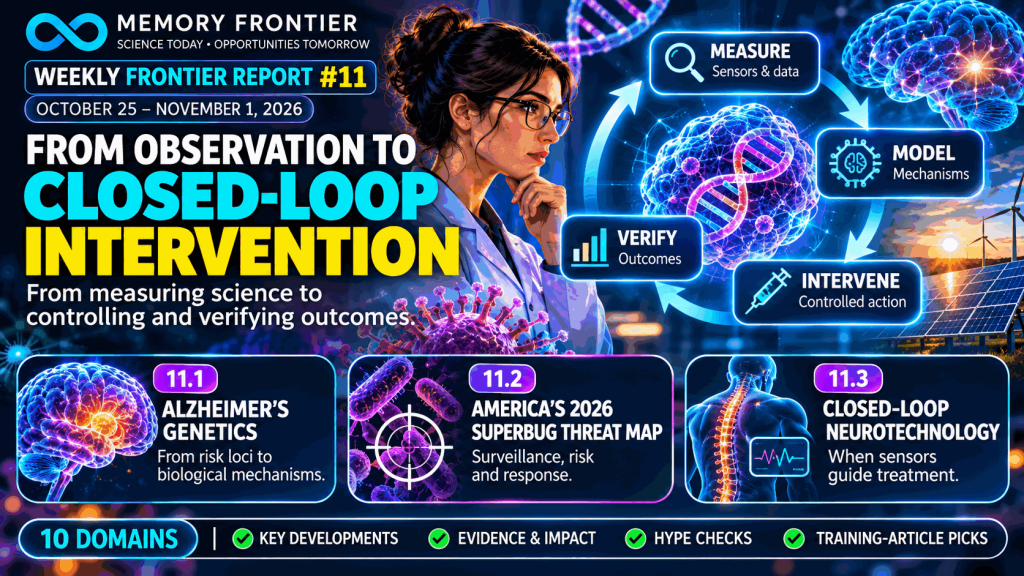
From observation → closed-loop intervention and verified outcomes.
Genetic mechanisms, antimicrobial surveillance and feedback-controlled neurotechnology show how measurement can inform testable intervention.
📊 Weekly snapshot
If you read only one section, read this
Alzheimer’s Genetics
From risk loci to biological mechanisms; genetics informs target discovery but does not establish treatment.
America’s 2026 Superbug Threat Map
Updated CDC estimates sharpen surveillance priorities; methods matter when comparing trends.
Closed-Loop Neurotechnology
Sensors, feedback and controlled interventions advance in experimental spinal-cord research.
What happened — why it matters
AI, Human Cognition & Artificial Agency
No qualifying seven-day agency breakthrough
What Happened: No sufficiently verified major advance in autonomous AI agency met the threshold in this reporting window.
Why It Matters: Agent benchmarks must demonstrate reliable task completion, oversight and recovery rather than impressive isolated examples.
Domain-Incubation Impact: Maintain an observatory for prospective evaluations and immutable safety controls.
Hype Check: No verified evidence this week of general autonomous agency or AI consciousness.
Training-Article: NO — monitor
Sources: No qualifying primary source identified for this window.
Consciousness & the Architecture of Experience
No verified seven-day consciousness breakthrough
What Happened: No qualifying study established a new causal mechanism of subjective experience during the window.
Why It Matters: Neural computation and behavioral performance are not direct demonstrations of subjective experience.
Domain-Incubation Impact: Prioritize preregistered rival-theory tests and converging causal measures.
Hype Check: Do not infer consciousness from neural complexity or AI output.
Training-Article: NO — hold
Sources: No qualifying primary source identified for this window.
AI-Driven Biology & Programmable Medicine
Alzheimer’s genetic risk maps converge on microglia and neurons
What Happened: A Nature multi-ancestry study reported 118 loci in a combined analysis and nine ancestry-specific loci, including 48 newly reported loci, implicating microglial and neuronal processes.
Why It Matters: Large genetic maps help prioritize mechanisms and candidate targets for experimental follow-up.
Domain-Incubation Impact: Develop genetics-to-target evidence graphs with ancestry-aware validation and explicit causal testing.
Hype Check: Genetic association does not prove that changing a gene will prevent or treat disease.
Training-Article: YES — TOP 1: Alzheimer’s Genetics
Sources: Nature primary research
Longevity, Regeneration & the Biology of Aging
Regeneration research reveals immune and transcriptional mechanisms
What Happened: New cavefish research implicated immune-cell responses in heart regeneration; planarian studies identified regulators associated with neuronal regeneration.
Why It Matters: Comparative regenerative biology provides mechanisms to test, not ready-made human therapies.
Domain-Incubation Impact: Track cross-species mechanistic replication, tissue specificity and safety endpoints.
Hype Check: Fish and planarian regeneration is not evidence of human rejuvenation.
Training-Article: YES — secondary candidate
Sources: Research summary / watchlist; primary citation to be confirmed before publication.
Brain-Computer Interfaces & Neurotechnology
Feedback-controlled spinal-cord perfusion in experimental research
What Happened: An October 29 Nature Biomedical Engineering research briefing described ultrasound measurement of spinal-cord blood flow coupled to automatic drug-infusion adjustment, with evidence from animal-model experiments.
Why It Matters: Neurotechnology is extending from decoding toward sensing and controlled physiological intervention.
Domain-Incubation Impact: Explore sensor fusion, control-loop stability, safety limits and prospective human validation.
Hype Check: Animal-model neurological preservation is not proven patient benefit.
Training-Article: YES — TOP 3: Closed-Loop Neurotechnology
Sources: Nature research briefing
Energy Abundance
Perovskite-silicon solar durability and fusion-plasma modeling
What Happened: A Nature Energy study reported laboratory performance and stress-test retention for bifacial perovskite/silicon tandem cells; DOE highlighted a modeling framework for fusion-plasma heating and impurities.
Why It Matters: Durability and realistic plasma modeling are important engineering constraints on future energy systems.
Domain-Incubation Impact: Monitor independent outdoor validation, manufacturing yield, system cost and fusion energy balance.
Hype Check: Laboratory stress testing is not decades of field reliability; fusion modeling is not commercial power generation.
Training-Article: YES — secondary candidate
Sources: Research summary / watchlist; primary citation to be confirmed before publication.
Climate Adaptation & Planetary Engineering
No qualifying seven-day breakthrough confirmed
What Happened: No independently verified major seven-day development met the report threshold. Earlier carbon-storage work falls outside the window.
Why It Matters: A disciplined weekly scan should not turn relevant background research into a newly dated breakthrough.
Domain-Incubation Impact: Continue monitoring urban heat-risk systems, carbon accounting and climate adaptation evidence.
Hype Check: Do not conflate modeling scenarios with demonstrated planetary intervention.
Training-Article: NO — hold
Sources: No qualifying primary source identified for this window.
Quantum Technologies & Post-Quantum Security
No qualifying new quantum or security breakthrough
What Happened: No verified seven-day milestone in fault-tolerant computing or post-quantum security met the editorial threshold.
Why It Matters: Reliability and cryptographic migration remain important, even without a weekly headline.
Domain-Incubation Impact: Track logical error rates, scalable architecture and cryptographic inventory migration.
Hype Check: Earlier published results and existing standards should not be presented as this week’s news.
Training-Article: NO — hold
Sources: No qualifying primary source identified for this window.
Antimicrobial Resistance & Next-Generation Infectious-Disease Defense
CDC refreshes the U.S. antimicrobial-resistance threat assessment
What Happened: CDC’s 2026 assessment estimates more than 9.3 million resistant infections and over 39,000 associated deaths annually in the United States; adding C. difficile raises the reported totals to roughly 9.7 million infections and 50,800 deaths.
Why It Matters: Updated burden estimates can focus surveillance, infection prevention, stewardship and laboratory preparedness.
Domain-Incubation Impact: Build pathogen-level risk dashboards with source provenance, confidence ranges and methods-aware historical comparisons.
Hype Check: Revised estimation methods mean comparisons with older reports cannot be interpreted as simple increases in incidence.
Training-Article: YES — TOP 2: America’s 2026 Superbug Threat Map
Sources: CDC antimicrobial resistance
Human-Machine Reality: Robotics, Spatial Computing & Embodied AI
No verified general-purpose robotics milestone
What Happened: No sufficiently verified seven-day development demonstrated broad gains in embodied-agent reliability across real-world tasks.
Why It Matters: A credible robotics signal requires repeated performance under deployment conditions.
Domain-Incubation Impact: Track interventions per task, generalization, contact safety, recovery and total cost.
Hype Check: A lab demo is not proof of dependable general-purpose autonomy.
Training-Article: NO — hold
Sources: No qualifying primary source identified for this window.
From Observation to Closed-Loop Intervention
Across genetic risk mapping, regenerative biology, antimicrobial surveillance and neurotechnology, the emerging opportunity is to link measurement with mechanisms, controlled intervention and independently verified outcomes. These are distinct research programs, not one integrated system.
Verification Infrastructure for Programmable Science
An incubator thesis: connect multimodal observations, causal models, controlled interventions, audit trails and independent outcome measurement. Track external replication, cost per verified improvement, failure modes, clinical utility and regulatory acceptance. This is a research hypothesis, not an established commercial platform.
🧪 Evidence discipline
Signal labels reflect editorial relevance, not readiness for deployment. Genetic associations are not treatments; CDC estimates are methodology-dependent; neurotechnology findings are experimental and not established human therapies. WATCH domains should not be filled with older news.
Research window: October 25–November 1, 2026. Confirm original study dates and methods before medical, engineering, investment or policy use.