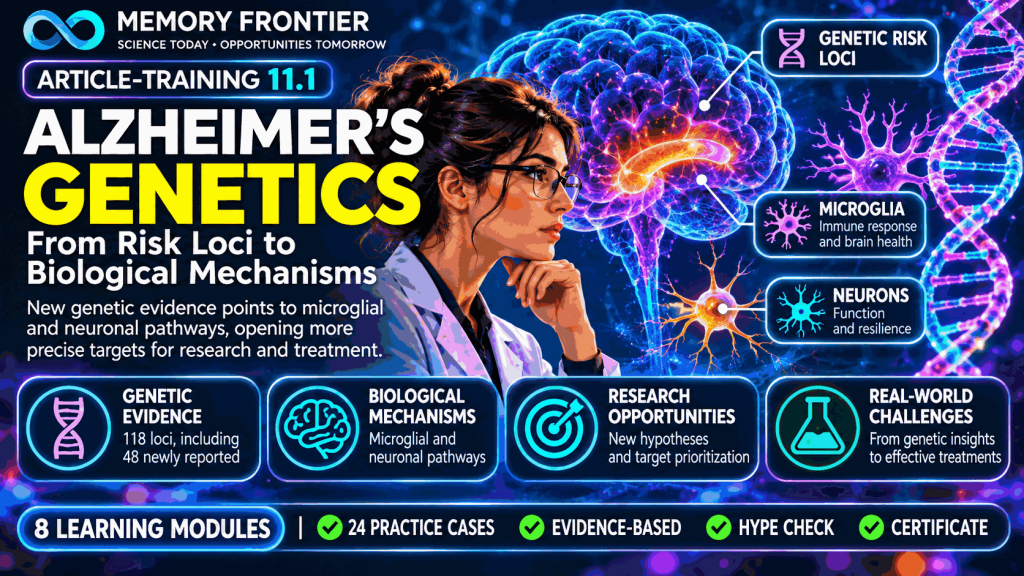
🧬 Alzheimer's Genetics: From Risk Loci to Biological Mechanisms
How can genetic associations help reveal the biological mechanisms behind Alzheimer’s disease?
Genetic studies identify regions associated with Alzheimer’s risk. Turning those signals into biological explanations requires diverse cohorts, causal fine-mapping, cell-specific experiments and careful validation. Association alone is not a diagnosis or a therapeutic breakthrough.
What a genetic locus means
An association locus identifies a genomic region linked statistically with disease risk, not necessarily a single causal gene.
Multi-ancestry evidence
Analyzing diverse populations can improve locus discovery and test whether effects transfer across genetic backgrounds.
Microglia and immune biology
Genetic signals may implicate immune-cell pathways; functional experiments must establish how these pathways influence disease.
Neuronal mechanisms
Neuronal pathways may appear alongside immune biology, suggesting interacting mechanisms rather than a single cause.
From association to causation
Fine-mapping, expression data and perturbation experiments help prioritize causal variants and genes.
Risk versus prediction
Relative genetic risk differs from absolute lifetime risk and does not determine an individual diagnosis.
Therapeutic translation
Targets require evidence of modifiable mechanisms, delivery feasibility, safety and clinical benefit.
Incubation: mechanism-to-target maps
A defensible incubator links reproducible genetic signals to cell models, perturbation and decision gates.
A genetic risk locus is not automatically a causal gene. A candidate mechanism is not yet a validated drug target. Promising laboratory findings do not demonstrate prevention, diagnosis or clinical benefit for patients. Distinguish association, functional evidence and clinical validation.
Go deeper: 8 modules · 24 practices
Explore the full English/Spanish interactive training, check your understanding, and unlock the Certificate of Participation after 50% participation.
https://hiapromo.com/frontier/11.1.-Alzheimer_s_Genetics_From_Risk_Loci_to_Biological_Mechanisms.html
Editorial note: Educational synthesis. Genetic findings and their interpretation should be verified against original studies; no individual clinical advice or therapeutic efficacy is implied.