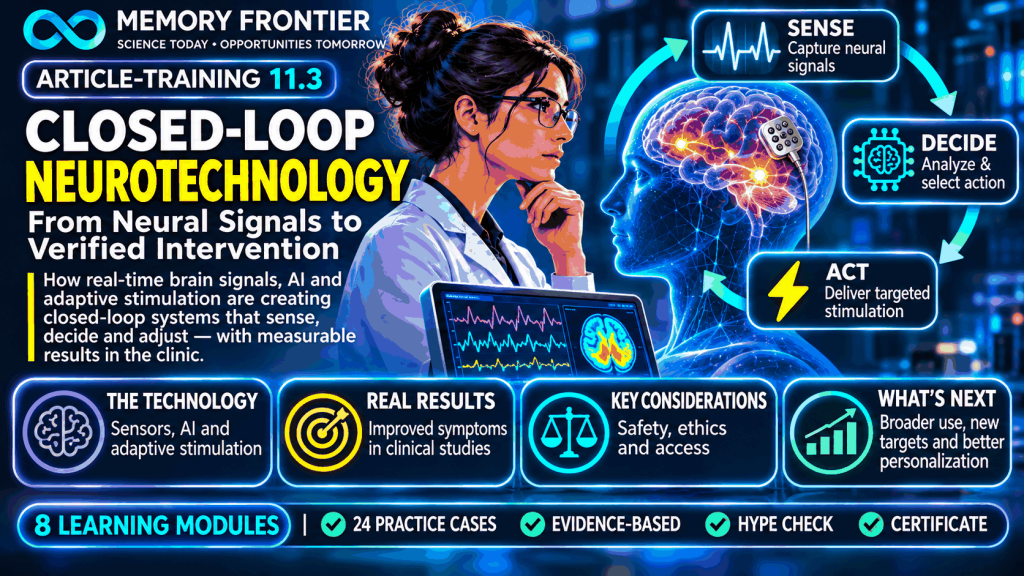
🧠 Closed-Loop Neurotechnology: From Neural Signals to Verified Intervention
What changes when neurotechnology can measure a biological signal, respond to it, and verify the result?
Closed-loop neurotechnology links sensing, estimation, controlled intervention and feedback. Experimental systems for spinal-cord physiology and prosthetic interfaces illustrate its promise, but technical feasibility, functional recovery and human clinical benefit require different kinds of evidence.
The open-loop limitation
Conventional open-loop interventions deliver a fixed or scheduled action without continuously adjusting to a measured response. Biological conditions can change over time, creating a reason to investigate feedback-guided control.
What makes a loop closed
A closed-loop system repeatedly measures a relevant signal, estimates the current state, selects an action within safety limits and measures the response. Feedback does not automatically make an intervention effective.
Signals and sensing
Possible inputs include neural activity, blood flow, muscle activity or other physiological measurements. Sensor accuracy, latency, artifacts and drift determine whether the input is dependable.
From measurement to control
Algorithms translate measured signals into constrained decisions such as changing stimulation or drug delivery. Control stability, dose limits and fail-safe behavior matter as much as predictive accuracy.
Spinal-cord perfusion as a case study
Experimental research has explored ultrasound-based measurement of spinal-cord blood flow coupled to responsive drug infusion. Findings in animal models motivate further investigation but do not establish benefit in routine human care.
Prosthetic feedback and interfaces
Wearable sensors and implanted markers can support research into real-time prosthetic control. Reliable performance must be evaluated across movements, environments, users and prolonged use.
What counts as verified benefit
Technical signal decoding, physiological improvement, functional recovery and patient-centered outcomes are separate evidence levels. Human studies need safety monitoring, suitable controls and clinically meaningful endpoints.
Incubation: auditable neurotechnology loops
An incubator thesis is a modular system that logs sensor quality, algorithm decisions, intervention limits, outcomes and human overrides. The opportunity remains a hypothesis until safety, reproducibility and real-world utility are demonstrated.
A functioning feedback loop is not proof of restored neurological function. Animal-model outcomes, prosthetic-control demonstrations and clinically validated patient benefit must not be conflated. Closed-loop control can also introduce sensor failures, inappropriate interventions and safety risks.
Go deeper: 8 modules · 24 practices
Explore the full English/Spanish interactive training, check your understanding, and unlock the Certificate of Participation after 50% participation.
https://hiapromo.com/frontier/11.3.-America_s_2026_Superbug_Threat_Map_Surveillance_Resistance_and_Public_Health_Decisions.html
Editorial note: Educational synthesis of experimental closed-loop neurotechnology concepts. Verify the underlying primary studies and their populations before drawing clinical conclusions. This is not medical advice.