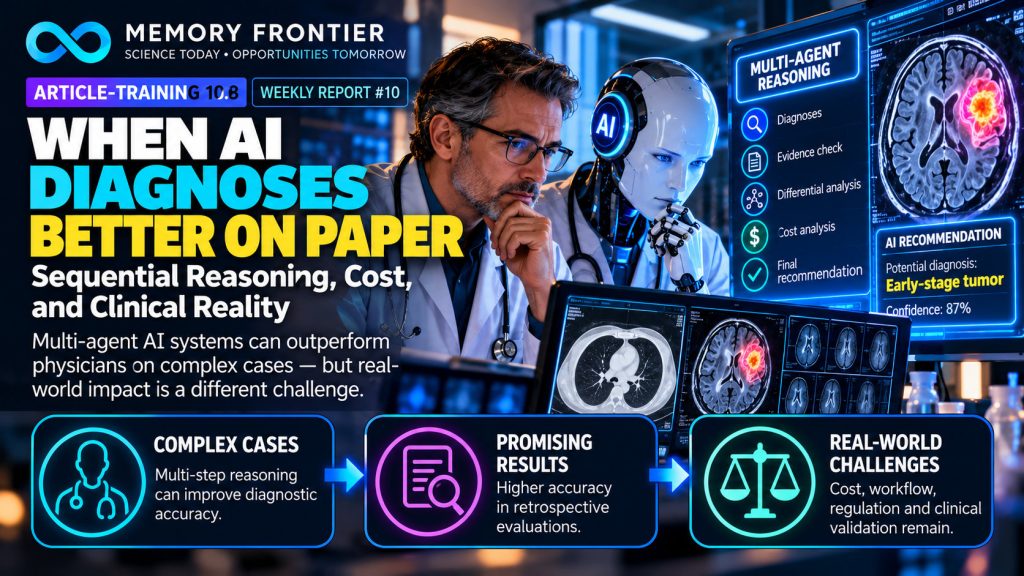
🧠 When AI Diagnoses Better on Paper: Sequential Reasoning, Cost, and Clinical Reality
Can AI agents outperform clinicians on difficult diagnostic benchmarks—and what would that actually prove?
Multi-agent AI systems can reason through challenging clinical cases and compare diagnostic hypotheses. Promising retrospective performance is worth studying, but does not establish safe, effective real-world clinical use.
The benchmark headline
A multi-agent diagnostic system reportedly achieved high accuracy on selected difficult cases. Before interpreting a headline score, inspect the case selection, reference standard, comparison group and evaluation protocol.
Sequential clinical reasoning
Multiple agents can propose diagnoses, critique competing hypotheses and request further evidence. A longer reasoning chain is not automatically more accurate, especially when agents share the same blind spots.
What the comparison measures
Retrospective diagnostic questions assess performance on a curated dataset. They do not reproduce real clinical encounters with incomplete histories, shifting prevalence, time pressure and patient preferences.
Accuracy versus clinical outcomes
A correct answer on a benchmark is different from improved patient outcomes. Useful evaluation also measures false negatives, triage safety, calibration, treatment decisions and potential harm.
Cost and operational burden
Multi-agent workflows can consume additional tokens, latency and computing resources. Compare incremental diagnostic value against costs and clinician time, rather than accuracy alone.
Bias, leakage and uncertainty
Dataset contamination, ambiguous ground truth, selection bias and correlated agent errors can inflate apparent performance. Independent external validation and transparent uncertainty reporting are essential.
Prospective validation and oversight
Clinical use requires prospective studies, workflow integration, privacy safeguards, monitoring and appropriate regulatory assessment. AI should support accountable clinicians, not silently replace them.
Incubation: verifiable clinical reasoning
A promising incubator direction is an auditable clinical decision-support layer that records evidence, disagreements, uncertainty, costs and human review. It remains a research and validation thesis, not an approved diagnostic product.
High performance on selected retrospective cases is not proof of clinical superiority, improved patient outcomes or deployment readiness. Independent testing, uncertainty calibration, safety monitoring, prospective trials and regulatory requirements remain distinct hurdles.
Go deeper: 8 modules · 24 practices
Explore the full English/Spanish interactive training, check your understanding, and unlock the Certificate of Participation after 50% participation.
https://hiapromo.com/frontier/10.3.-Cells_That_Remember_Recordanelles_and_the_End_of_One_Time_Snapshots.html
Editorial note: This educational synthesis distinguishes retrospective AI evaluation from prospective clinical evidence. Verify the original diagnostic study, comparison design and clinical applicability before drawing practical conclusions.