🦠 America’s 2026 Superbug Threat Map: Surveillance, Resistance, and Public-Health Decisions
What do national antimicrobial-resistance estimates tell us—and what do they leave uncertain?
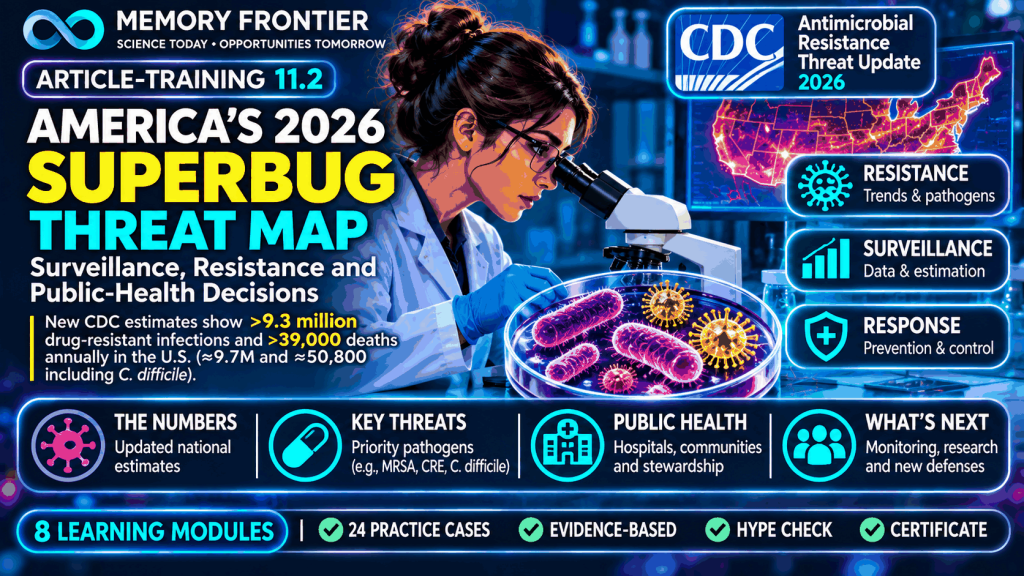
The 2026 CDC antimicrobial-resistance assessment updates the scale of the U.S. threat. Understanding these estimates requires attention to surveillance coverage, pathogen definitions, prevention, and methodological uncertainty. Numbers guide public-health priorities; they do not replace patient-level clinical decisions.
What antimicrobial resistance measures
Antimicrobial resistance occurs when pathogens survive treatments designed to control them. Burden estimates must distinguish resistant infections, associated deaths and deaths attributable to resistance.
The surveillance denominator
A surveillance estimate depends on which pathogens, populations, settings and reporting systems are included. Missing observations and model assumptions can change the apparent national burden.
Threat categories and burden
Public-health agencies prioritize threats using infection frequency, severity, resistance patterns, spread and prevention opportunities. Categories are decision aids, not a prediction for an individual patient.
Healthcare-associated transmission
Hospitals and long-term-care settings can amplify resistant infections through vulnerable patients, invasive devices and opportunities for transmission. Infection prevention and stewardship work together.
Community and environmental pathways
Resistant organisms and resistance genes can circulate beyond hospitals. Community, animal and environmental surveillance can complement clinical laboratory data.
Diagnostics and stewardship
Timely identification, susceptibility testing and appropriate antimicrobial selection support care and reduce unnecessary antibiotic exposure. Surveillance should guide decisions without replacing clinical judgment.
Comparing annual estimates
Changes in surveillance coverage, modeling, pathogen definitions and inclusion of C. difficile can make year-to-year comparisons misleading. Always check the methodology before claiming an increase.
Incubation: actionable threat intelligence
An incubator opportunity is an auditable pipeline connecting laboratory reports, denominators, trends, uncertainty and actionable alerts, evaluated for usefulness and unintended consequences.
Surveillance estimates are not exact counts of every infection. Do not interpret changes from older CDC assessments as direct trends without checking methods and pathogen coverage. The presence of resistance does not mean every infection is untreatable; clinical outcomes depend on organism, drug, patient and setting.
Go deeper: 8 modules · 24 practices
Explore the full English/Spanish interactive training, check your understanding, and unlock the Certificate of Participation after 50% participation.
https://hiapromo.com/frontier/11.2.-America_s_2026_Superbug_Threat_Map_Surveillance_Resistance_and_Public_Health_Decisions.html
Editorial note: Educational synthesis based on antimicrobial-resistance surveillance concepts. Check the CDC 2026 assessment and its methods before interpreting national estimates or trends. This is not individual medical advice.