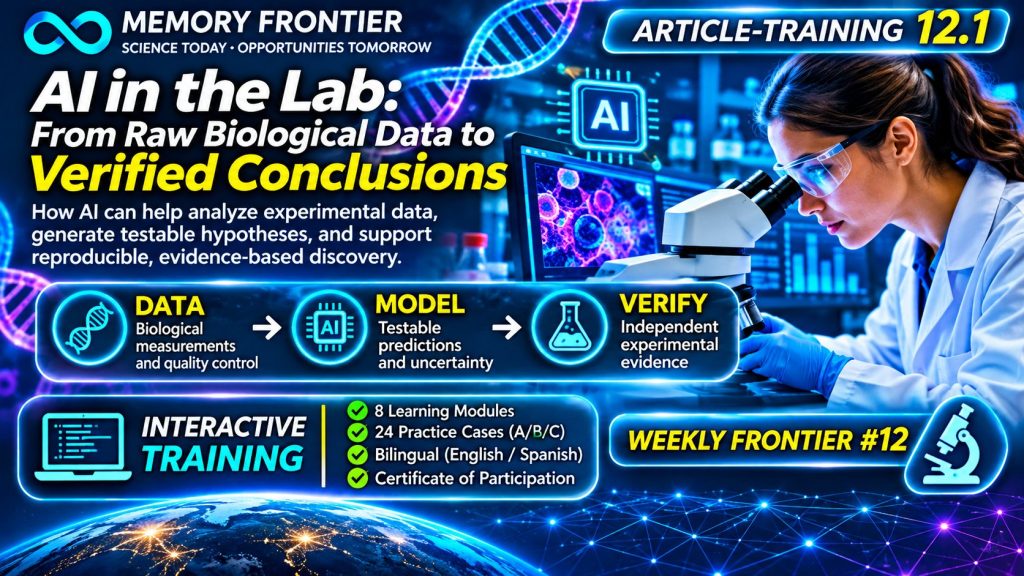
🧬 AI in the Lab: From Raw Biological Data to Verified Conclusions
Can artificial intelligence accelerate biological discovery without confusing predictions with scientific proof?
Artificial intelligence can help researchers analyze sequencing data, microscopy images and experimental measurements. But discovering a statistical pattern is not the same as establishing a biological mechanism. Reliable AI-assisted science requires data quality, controlled experiments, independent validation and reproducible conclusions.
Biological data are measurements
DNA sequencing, microscopy and laboratory assays produce observations influenced by sampling procedures, instruments and experimental conditions. These measurements are informative but imperfect representations of biological reality.
Quality control before modeling
Missing values, contamination, mislabeled samples and batch effects can produce misleading results. Reliable scientific pipelines examine these problems before training machine-learning models, documenting every transformation applied to the data.
Separating training and testing
A model may appear highly accurate when related samples or information from the same experiment appear in both training and testing datasets. Splitting data by specimen, patient or experimental batch, where appropriate, helps reduce leakage and gives a more credible estimate of generalization.
Prediction versus biological mechanism
Machine learning can identify relationships between molecular measurements and biological outcomes. However, predictive accuracy does not automatically reveal causation. Mechanistic explanations require additional experiments that distinguish competing biological hypotheses.
Experimental confirmation
AI-generated hypotheses should be challenged through appropriate controls, biological replicates and independent measurement methods. Experimental confirmation is stronger when alternative explanations are considered and the findings remain reproducible across suitable conditions.
Reproducible computational pipelines
Scientific reproducibility depends on more than publishing a final chart. Dataset versions, preprocessing operations, software dependencies, model configurations and evaluation procedures must be documented so independent teams can examine and repeat the analysis.
Uncertainty and generalization
A successful result in one laboratory may not transfer to different instruments, populations or experimental protocols. Researchers should report uncertainty, investigate failures and evaluate performance on genuinely independent datasets before making broad scientific claims.
Incubation: verified scientific discovery
An emerging incubator opportunity is an auditable discovery pipeline connecting raw biological data, AI-generated hypotheses, experimental protocols, measured results and independent review. The objective is not simply faster prediction, but a shorter and more reliable path from computational insight to verified scientific knowledge.
High model accuracy does not prove biological causation, successful laboratory validation or clinical effectiveness. A promising computational result remains a hypothesis until appropriate experiments support it. The proposed incubation opportunity is a strategic interpretation, not proof of an established commercial or scientific breakthrough.
Go deeper: 8 modules · 24 practices
Explore the full English/Spanish interactive training, check your understanding, and unlock the Certificate of Participation after 50% participation.
https://hiapromo.com/frontier/12.1.-AI_in_the_Lab_From_Raw_Biological_Data_to_Verified_Conclusions.html
Editorial note: This article is an educational synthesis of AI-assisted biological research and scientific validation principles. Specific research claims should be verified against primary publications, including their dates, methods and experimental populations. This is not medical advice.