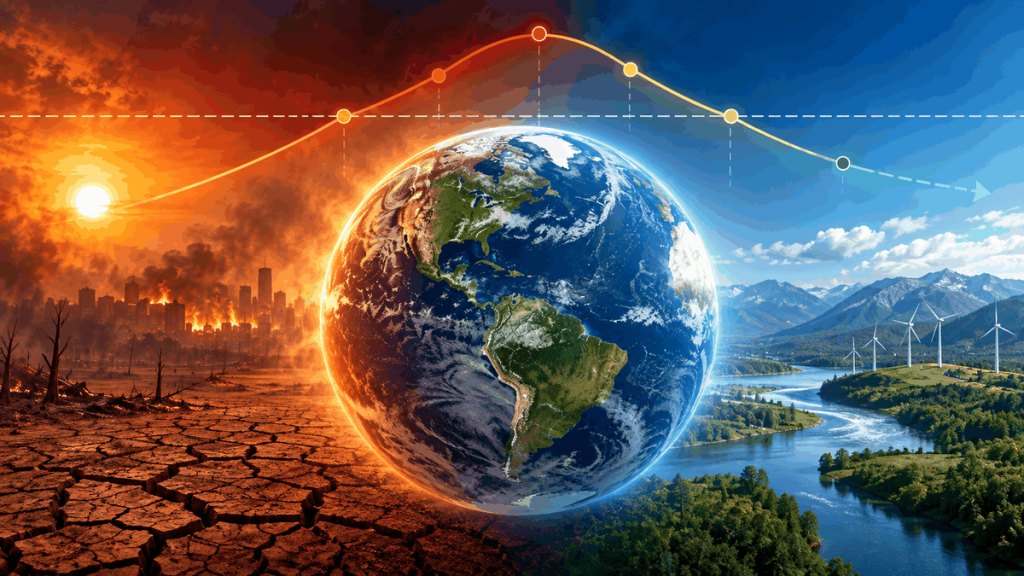
Climate strategy is entering a different phase.
For decades, much of the global climate conversation has focused on preventing temperatures from crossing critical warming thresholds.
That objective remains essential. But a more difficult planning problem is becoming increasingly visible:
overshoot.
What happens when a warming threshold is exceeded — and the world must manage what comes next?
Recent UNEP analysis describes a world in which temporarily exceeding 1.5°C is widely assessed as unavoidable under current policies
and plausible near-term trajectories. This does not make the 1.5°C goal irrelevant.
It means strategy must increasingly address how high temperatures rise, how long the exceedance lasts,
and how quickly warming can subsequently decline.
Crossing a threshold is only one stage of the story.
Exceedance → Peak → Decline → Stabilization → Possible Return Below the Threshold
Each stage matters. A world that briefly exceeds 1.5°C and then reduces warming is different from one that continues rising for decades.
The magnitude and duration of the overshoot influence the risks accumulated along the way.
How high warming goes and how long it remains elevated are both critical.
Higher temperatures can intensify climate hazards. Longer exposure can increase cumulative stress on ecosystems,
infrastructure, agriculture, water systems, economies, and human communities.
Overshoot therefore does not create a binary world in which climate action has either succeeded or failed.
It creates a continuous risk-management problem.
Every fraction of a degree — and every additional year of warming —
still matters.
Exceeding 1.5°C makes emissions reduction more important, not less.
Rapid mitigation remains central because emissions determine how high warming peaks and how difficult it becomes to bring temperatures back down.
Reduce Emissions → Reach Net Zero → Limit Peak Warming → Sustain Net-Negative Conditions Where Appropriate → Reduce Temperatures
Societies must reduce future warming while managing the impacts already occurring.
Adaptation becomes a parallel requirement rather than a substitute for mitigation.
- Heat-resilient infrastructure
- Flood protection
- Water management
- Climate-resilient agriculture
- Wildfire preparedness
- Coastal protection
- Public-health systems
- Early-warning systems
- Urban cooling
- Ecosystem restoration
Bringing temperatures back down may eventually require more than emissions reduction alone.
Carbon dioxide removal can become part of the pathway if temperatures significantly overshoot a target and later need to decline.
But carbon removal introduces its own questions involving scale, permanence, energy, land, cost, measurement,
governance, and environmental consequences. It should not be treated as a simple substitute for near-term emissions reductions.
Temperature increasingly looks like a dynamic system to be managed over time.
Measure → Project → Mitigate → Adapt → Remove → Measure Again → Correct
Policies and interventions influence emissions. Emissions influence atmospheric concentrations.
Concentrations influence temperature. Temperature influences physical and societal risk.
Measurements then inform the next decisions.
Not all large-scale climate interventions are equivalent.
Emissions reduction, adaptation, carbon dioxide removal, and solar-radiation modification address different parts of the climate system
and carry very different evidence bases and risk profiles. Technical possibility does not automatically establish environmental safety,
political legitimacy, scalability, or appropriate governance.
The objective is to minimize both the magnitude and duration of overshoot.
Exceedance → Minimize Peak → Adapt → Net Zero → Net Negative → Temperature Decline
Progress at one stage does not eliminate the importance of the others.
The objective is to reduce the damage accumulated during overshoot while preserving the possibility of lowering temperatures afterward.
Climate strategy now has to combine prevention, adaptation, recovery, and long-term temperature management.
This is not an argument for abandoning climate targets.
It is an argument for treating every additional increment of warming as consequential.
The frontier therefore moves from “Can we prevent threshold exceedance?”
toward the broader systems question:
“How do we minimize the peak, manage the impacts, and bring temperatures back down as safely and quickly as possible?”
Explore the climate-overshoot problem in greater depth
The complete Article-Training provides a guided exploration through:
- Learning modules
- 12 interactive practice cases
- Climate-overshoot scenarios
- Mitigation and adaptation decisions
- Evidence-versus-projection exercises
- Critical-thinking exercises
- English / Spanish learning experience
- Participation tracking
- Research grounding
- Certificate of Participation
Climate overshoot is a scenario and risk-management framework grounded in climate-model projections and current emissions trajectories.
The exact magnitude, timing, and duration of future warming remain dependent on emissions, policies, technological development,
Earth-system responses, and other uncertainties. Overshoot should therefore not be interpreted as evidence that a specific future
temperature pathway is predetermined, nor as justification for delaying mitigation.
Continue with the complete learning experience
Explore the complete interactive learning experience, work through the 12 practice cases,
and generate your Certificate of Participation.