🤖 Embodied AI in the Real World: From Robot Demonstrations to Verified Operations
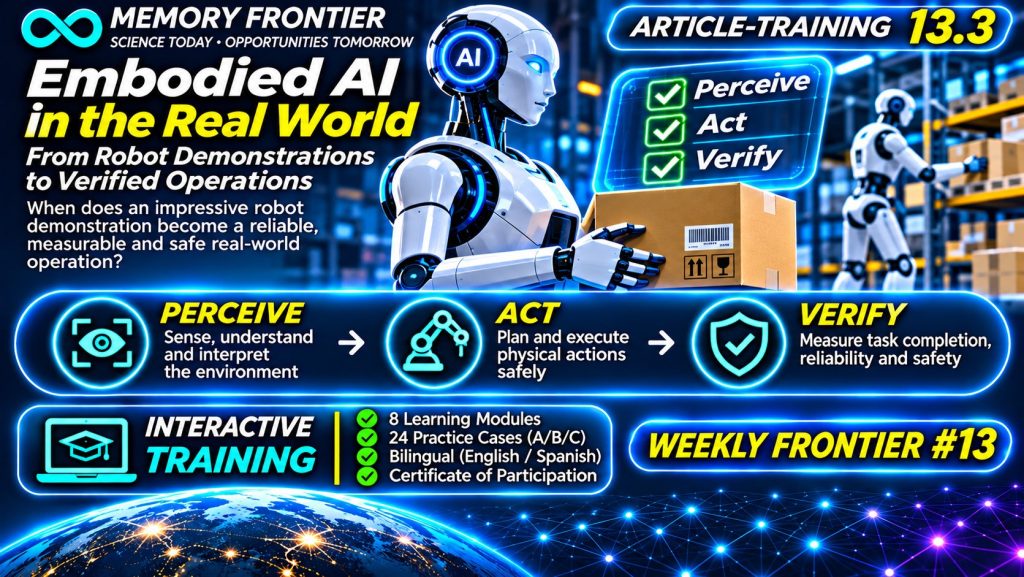
When does an impressive robot demonstration become a reliable, measurable and safe real-world operation?
Embodied AI connects perception, reasoning and physical action. Robots can demonstrate sophisticated manipulation, navigation and task planning under controlled conditions. But operational readiness requires more than a successful demonstration: systems must perform consistently across changing environments, recover from failures, respect safety boundaries and deliver independently verified outcomes.
From simulation to physical reality
Simulation allows researchers to train and evaluate robotic behavior under repeatable conditions. Physical environments introduce friction, lighting changes, sensor noise, object variability and unpredictable interactions. This simulation-to-reality gap means that performance in a virtual environment cannot automatically establish real-world reliability.
Perception and environmental understanding
Robots combine cameras, depth sensors, force measurements and other inputs to estimate their surroundings. Successful perception requires recognizing objects, understanding spatial relationships and detecting changes during execution. Errors in localization, object identification or sensor calibration can propagate into unsafe physical actions.
Planning and physical action
An embodied system must translate goals into feasible movements and tool interactions. Planning may involve selecting an object, calculating a grasp, avoiding obstacles and coordinating multiple actions. High-level AI reasoning does not replace the need for stable low-level control, collision avoidance and physically achievable trajectories.
Generalization beyond demonstrations
A robot may succeed repeatedly with familiar objects and still struggle with different shapes, materials, layouts or instructions. Evaluation should include previously unseen tasks and environments. Generalization must be demonstrated through systematic testing rather than inferred from selected videos or isolated successful trials.
Reliability and recovery
Operational evaluation must examine repeated task success, time to completion, intervention frequency and recovery after errors. A dropped object, unexpected obstacle or sensor failure should trigger a defined response. Systems that require frequent human rescue may remain useful research prototypes without yet qualifying as dependable autonomous operations.
Safety and human oversight
Physical AI introduces risks involving collisions, unintended movement, equipment damage and human injury. Operational safeguards may include speed and force limits, protected workspaces, emergency stops, independent safety monitoring and human intervention. Safety must be evaluated for the specific robot, task and environment rather than assumed from general AI capabilities.
Measuring operational readiness
A meaningful evaluation framework should report end-to-end task completion, success across repeated trials, failure severity, recovery time, human intervention, throughput and operational cost. Results should identify testing conditions and uncertainty. A robot that completes a task once is not equivalent to a system that performs the same task reliably over thousands of operational cycles.
Incubation: verifiable embodied operations
An emerging incubator opportunity is a verification layer for robotic operations that connects sensor observations, action logs, safety events, task outcomes and human interventions. Such infrastructure could help organizations compare robotic systems using reproducible evidence rather than demonstration quality alone. Commercial value remains a hypothesis requiring field validation and measurable operational benefits.
A compelling robot video does not establish general intelligence, reliable autonomy or safe deployment. Simulation benchmarks, controlled laboratory demonstrations and sustained field operations represent different evidence levels. Claims about widespread humanoid replacement of human labor, universal robotic capabilities or near-term autonomous deployment should be treated as projections unless supported by independently verified operational data.
Go deeper: 8 modules · 24 practices
Explore the full English/Spanish interactive training, examine practical robotic reliability scenarios, check your understanding and unlock the Certificate of Participation after 50% participation.
https://hiapromo.com/frontier/13.3.-Embodied_AI_in_the_Real_World_From_Robot_Demonstrations_to_Verified_Operations.html
Editorial note: Educational synthesis of embodied AI, robotic control, operational reliability and safety evaluation. Verify primary studies, experimental conditions and independent field results before treating specific performance claims as established. Incubation opportunities described here are hypotheses, not demonstrated commercial outcomes.