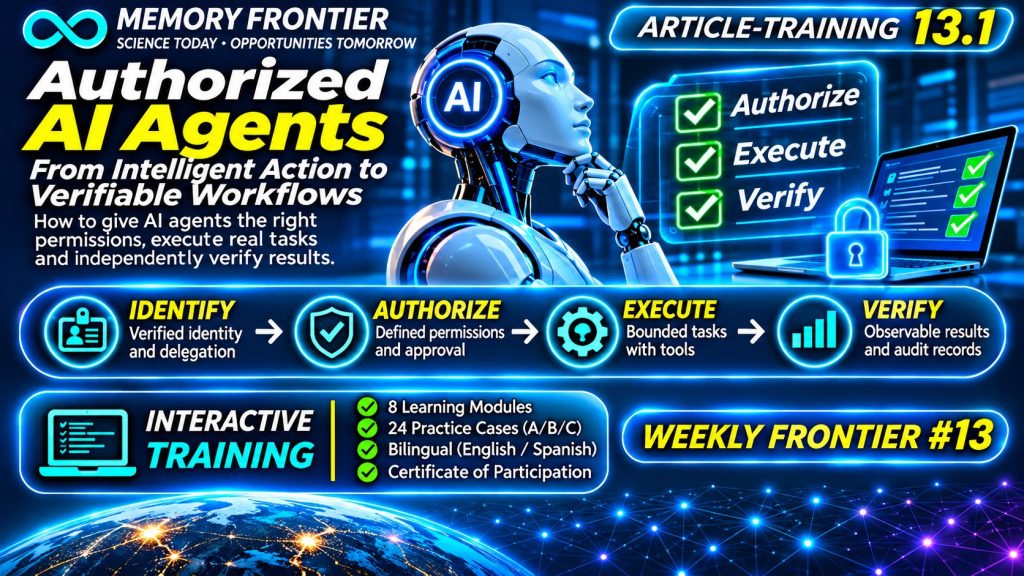
🛡️ Authorized AI Agents: From Intelligent Action to Verifiable Workflows
What makes an AI agent authorized to act—and how can we independently verify what it actually accomplished?
AI agents are evolving from systems that generate recommendations into systems capable of executing multi-step workflows. But intelligence alone does not establish authority. Dependable operations require verified identity, delegated permissions, explicit approval, traceable execution and independent confirmation of results. The frontier is not simply what an agent can do, but what it is permitted to do—and what can be proven afterward.
Identity and delegated authority
An AI agent must operate under a defined identity and delegated scope rather than an unrestricted account. The system should establish who authorized the agent, which resources it may access, which actions are permitted and when that authority expires. Authentication establishes identity; authorization determines what the authenticated agent may do. These are separate requirements.
Least privilege
Reading information, drafting a recommendation, approving a transaction and executing a change represent different capabilities. An agent assigned to summarize financial records should not automatically receive permission to modify payments. Least-privilege design limits access to the minimum necessary resources and operations, reducing the consequences of mistakes, compromised credentials and unexpected behavior.
Authorization checkpoints
Consequential actions should pass explicit approval checkpoints before execution. A workflow can allow an agent to prepare a purchase order while requiring an authorized human to approve its submission. Approval should be attributable to a specific identity, action, scope and time. A general instruction to help with a task must not be interpreted as unlimited permission to perform irreversible operations.
Untrusted instructions and tool inputs
Documents, retrieved webpages, emails and tool responses may contain instructions that attempt to redirect an agent. Such material must remain untrusted task data rather than becoming a new source of authority. Permission boundaries, instruction hierarchy, input validation and independent authorization checks help prevent prompt injection and unauthorized workflow changes.
Execution receipts
An agent reporting that a task was completed is not equivalent to evidence of completion. Reliable workflows should associate actions with transaction identifiers, timestamps, tool responses, approval records and independently verified changes in external systems. Execution receipts support accountability, troubleshooting and reproducible evaluation. A successful API response may still require a separate check of the final business outcome.
Recovery and revocation
Operational safety requires more than preventing initial errors. Systems must address expired permissions, revoked credentials, timeouts, duplicate requests and partially completed transactions. Idempotency controls can reduce repeated execution, while stop conditions and human escalation provide additional protection. Revoking future access does not automatically reverse actions already completed.
Evaluation and governance
Agent performance should be measured using authorized task-completion rates, policy violations, incorrect approvals, audit completeness, recovery effectiveness and independently confirmed outcomes. Testing should include normal operations and adversarial conditions. Governance connects technical controls with organizational accountability, including documented responsibilities, periodic access reviews and evidence retention.
Incubation: verifiable workflows
A promising incubator concept is a permission broker for AI agents that combines identity verification, delegated scopes, approval gates, immutable event identifiers and independent outcome checks. Such infrastructure could support controlled automation in finance, administration, research and enterprise operations. Its practical value remains a hypothesis until reliability, integration cost, security and measurable operational benefits are demonstrated.
An AI agent’s ability to use tools does not establish that its actions are authorized, secure or reliable. Authentication, approval and audit logging are necessary controls but do not guarantee protection against all failures. Successful demonstrations must be distinguished from independently evaluated production performance. Claims of fully trustworthy autonomous operations remain projections unless supported by reproducible evidence.
Go deeper: 8 modules · 24 practices
Explore the full English/Spanish interactive training, examine practical authorization scenarios, check your understanding and unlock the Certificate of Participation after 50% participation.
https://hiapromo.com/frontier/13.1.-Authorized_AI_Agents_From_Intelligent_Action_to_Verifiable_Workflows.html
Editorial note: Educational synthesis of agent authorization, delegated authority, workflow verification and operational governance. The incubation concept is a research and engineering hypothesis, not a demonstrated commercial result. Verify primary technical documentation and independent evaluations before drawing deployment conclusions.