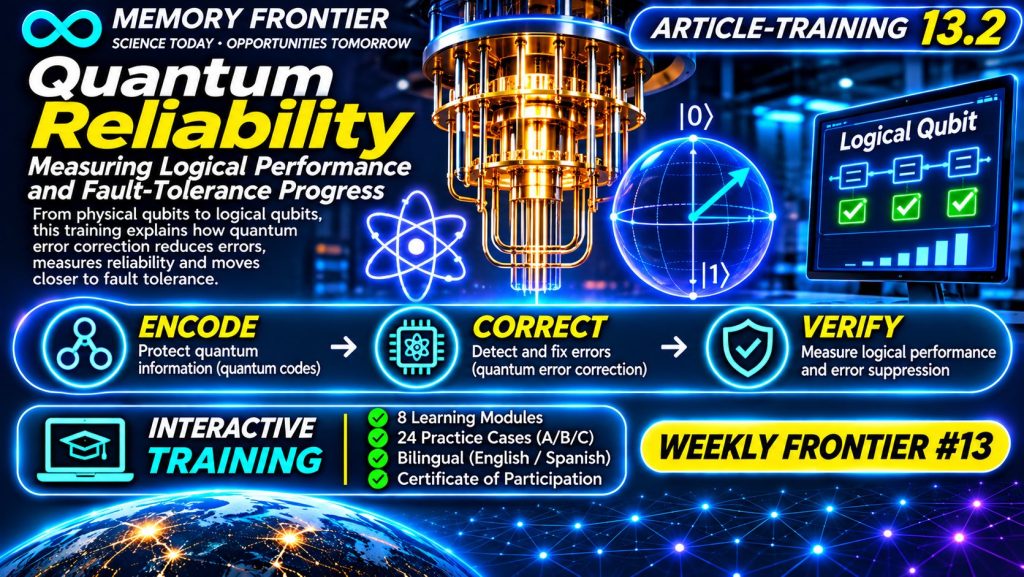
⚛️ Quantum Reliability: Measuring Logical Performance and Fault-Tolerance Progress
How do we know whether a quantum computer is becoming genuinely more reliable—not merely larger?
Quantum error correction aims to protect encoded information despite noisy physical hardware. Its progress must be assessed through carefully defined logical error rates, reproducible tests and the resources needed to perform useful operations. The central challenge is moving from isolated demonstrations to verifiable fault-tolerant performance.
Physical versus logical qubits
Physical qubits are imperfect physical devices. Logical qubits encode quantum information across multiple physical qubits so that selected errors can be detected and corrected. The encoding requires additional hardware and control resources; it does not eliminate noise.
Noise and error channels
Quantum operations can be affected by decoherence, imperfect gates, readout errors and correlated noise. An error model should describe which failures occur, how frequently they occur and whether assumptions match the tested device.
Syndrome extraction
Quantum error correction uses repeated measurements of error syndromes to infer faults without directly measuring the encoded quantum information. Reliable syndrome extraction itself depends on imperfect circuits, measurement fidelity and repeated correction cycles.
Logical error-rate benchmarks
Logical error rates should be reported with their exact definitions, circuit conditions, confidence intervals and number of experimental trials. Compare like with like: a per-cycle logical memory error rate is not interchangeable with a logical gate error rate.
Scaling and thresholds
Increasing code distance can suppress logical errors when the physical noise and decoder meet suitable conditions. Real systems must also account for qubit overhead, correlated failures, calibration drift and the complexity of scaling control electronics.
Decoding and real-time control
A decoder interprets syndrome data and determines corrective updates. Latency, throughput and error-model mismatch affect whether decoding can keep pace with physical operations. Offline decoding success is not sufficient proof of real-time fault-tolerant performance.
Useful fault-tolerant operations
Practical fault tolerance requires more than protecting stored quantum states. It must support accurate logical gates, state preparation, measurement and sufficiently long computations at an acceptable resource cost. Demonstrating one reliable operation does not establish a general-purpose machine.
Incubation: reliability scorecard
A useful incubator concept is a vendor-neutral scorecard that records physical error assumptions, logical error metrics, code distance, decoder latency, qubit overhead and independently reproducible workloads. Demand and commercial value must be validated rather than assumed.
A low logical error rate in a specified experiment is not proof of universal fault tolerance. Physical-qubit count, logical memory performance, logical gate fidelity and useful algorithm execution are different milestones. Conference talks and company claims require examination of methods, independent replication and publication status before being treated as established breakthroughs.
Go deeper: 8 modules · 24 practices
Explore the full English/Spanish interactive training, check your understanding and unlock the Certificate of Participation after 50% participation.
https://hiapromo.com/frontier/13.2.-Quantum_Reliability_Measuring_Logical_Performance_and_Fault_Tolerance_Progress.html
Editorial note: Educational synthesis of quantum error-correction concepts and reliability evaluation. Verify original experiments, publication status, benchmark definitions and uncertainty before treating particular performance claims as independently established.