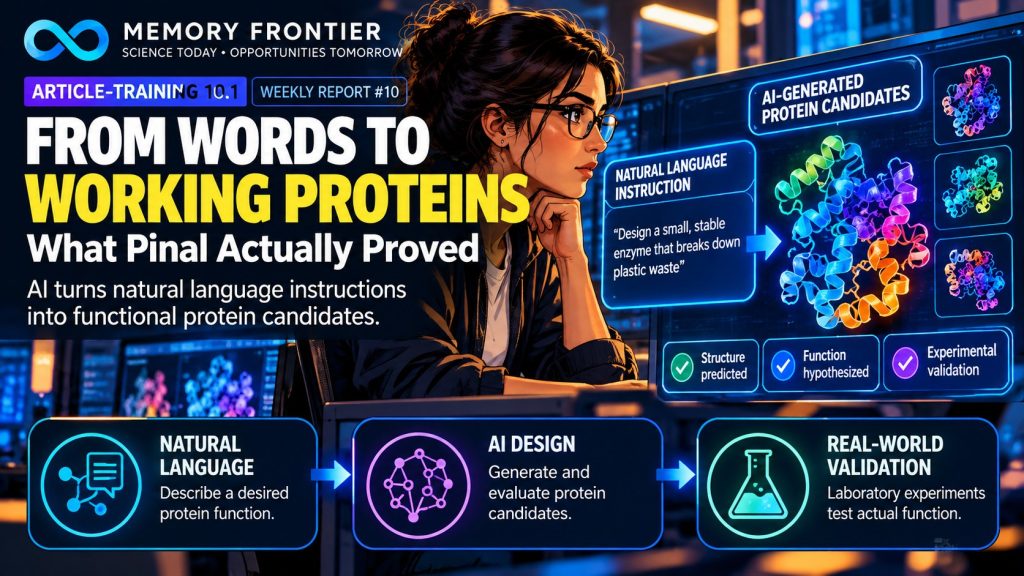
🧬 From Words to Working Proteins: What Pinal Actually Proved
Can a plain-language instruction become a functional protein—and what evidence would prove it?
AI-assisted protein design can translate a description of a desired biological function into candidate amino-acid sequences. The essential question is whether those candidates can be produced, tested and shown to perform the intended function under defined experimental conditions.
The instruction-to-protein idea
A natural-language request describes a desired biochemical function; a generative system proposes protein sequences.
Sequence is not function
A plausible amino-acid sequence may fold poorly, fail to bind, or be inactive in the target assay.
The experimental bridge
Expression, purification and activity assays connect computational proposals to measured biology.
Four functions are not all functions
Reported validation across several function types is encouraging, but does not establish unrestricted protein design.
Evaluate success rates
Ask how many sequences were proposed, how many were tested and how many met prespecified thresholds.
Compare meaningful baselines
Compare against established computational and experimental design methods with matched resources.
Safety and dual use
Protein generation requires screening, biosafety governance and appropriate access controls; computational plausibility is not safety.
Incubation: verified design loop
An incubator can test an auditable loop: requirement → candidate → assay → revision, with cost and reproducibility tracked.
Experimental validation of selected protein functions does not establish universal protein design, therapeutic effectiveness, or clinical safety. Track tested candidates, assay conditions, failure rates and independent replication before projecting broad applications.
Go deeper: 8 modules · 24 practices
Explore the full English/Spanish interactive training, check your understanding, and unlock the Certificate of Participation after 50% participation.
https://hiapromo.com/frontier/10.1.-From_Words_to_Working_Proteins_What_Pinal_Actually_Proved.html
Editorial note: This post is an educational synthesis. Consult the original Pinal research and its experimental methods before drawing medical, commercial or engineering conclusions.