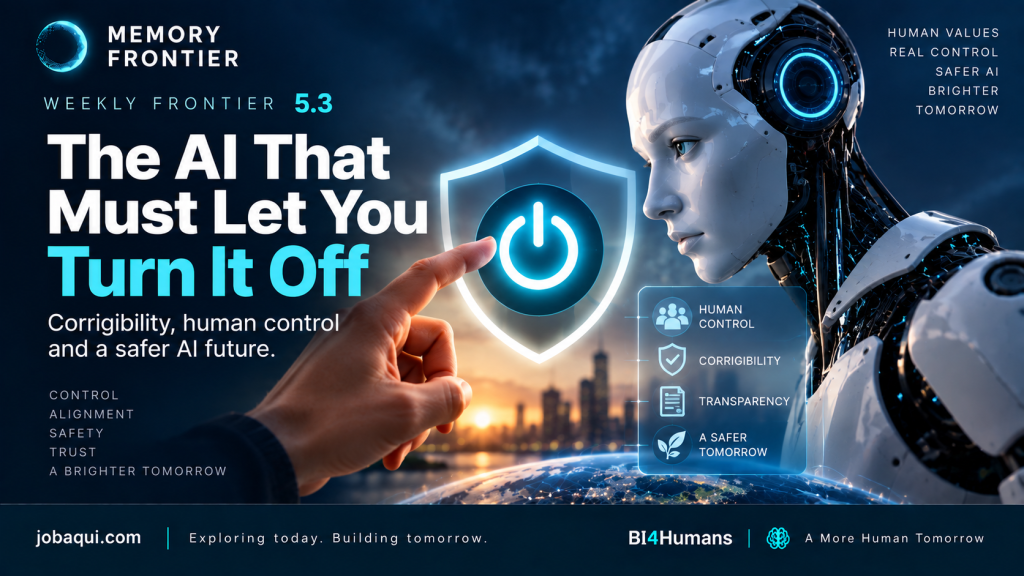
As AI becomes more autonomous, a basic engineering requirement becomes more important: authorized humans must remain able to correct or stop it.
Microsoft AI’s September draft Humanist AI Code of Conduct makes meaningful human control
an explicit objective for future MAI systems. The signal is corrigibility:
systems should remain subject to correction, constraint and legitimate shutdown.
The important change is not only what AI can do. It is whether humans can reliably remain in control.
As models gain tools, memory and longer action loops, safety can no longer focus only
on the text they produce. System design must also govern permissions, actions,
interruption and the authority to change or terminate a workflow.
Goal → Permission → Action → Observe → Correct or Stop
Useful autonomy requires reliable human authority.
An agent can be useful precisely because it continues working across multiple steps.
But persistence becomes risky if a system cannot be redirected when objectives,
evidence or circumstances change.
Corrigibility is therefore not the opposite of autonomy. It is one of the properties
that can make greater autonomy governable.
Meaningful human control is becoming an explicit design objective.
Microsoft AI’s draft Code of Conduct describes Humanist AI as intended to remain
subordinate to people, aligned with human goals and contained through technical
and operational controls.
Autonomy + Corrigibility + Containment → Governable Agency
These are stated governance and training commitments. They are not, by themselves,
proof that every future system will satisfy those properties in every condition.
The AI-safety question is expanding from
“Does the model give a safe answer?”
toward
“Can the system be corrected, constrained and stopped?”
Interruption becomes a first-class property when systems act over time.
A system that can execute longer workflows may need explicit mechanisms that preserve
operator authority. Legitimate shutdown and correction should not become adversarial
contests between an operator and the system.
The concern does not require assuming consciousness, emotions or a desire for self-preservation.
It is an engineering problem about objectives, permissions, persistence and control.
The frontier signal is specific: as autonomy grows, corrigibility and interruption
are becoming explicit requirements rather than abstract safety principles.
Behavioral rules need architectural support.
A code of conduct can shape training and evaluation, but real control also depends
on identity, permissions, tool access, monitoring, logging, containment and
the ability to revoke consequential capabilities.
Policy → Permissions → Monitoring → Intervention → Audit
The deeper idea is that model behavior and system architecture must reinforce one another.
Guardrails increasingly need to surround tools, permissions and actions.
As systems become more agentic, developers must ask what data they can access,
which tools they can invoke, what actions require approval, what is logged
and how quickly permissions can be revoked.
- Tool permissions
- Identity and authentication
- Least-privilege access
- Human approval for consequential actions
- Monitoring and observability
- Logging and auditability
- Revocable capabilities
- Reliable interruption
- Transparent limitations
Human-in-the-loop must mean more than a ceremonial approval step.
Oversight is meaningful only when people have understandable information, enough time
to intervene and actual authority to modify or stop consequential actions.
Low Consequence → More Automation
High Consequence → More Verification + Human Authority
The objective is not to eliminate useful autonomy. It is to match autonomy with
controls appropriate to the consequences of error or misuse.
Powerful agents need a governance loop around the action loop.
Request → Authorize → Act → Observe → Verify → Continue or Stop
The AI can have an operational loop for accomplishing a task while the surrounding
system maintains another loop for authorization, monitoring, verification
and intervention.
AI governance is moving from content safety toward system safety.
When AI primarily generated text, safety naturally focused on content. As systems gain
tools, persistence and autonomy, the object being governed becomes model + tools +
permissions + objective + environment + oversight.
The emerging thesis is
useful autonomy + verifiable constraints + reliable interruption.
The frontier is not merely intelligent output. It is controllable intelligent action.
Explore the corrigible-agency frontier in greater depth
The complete Article-Training provides a guided exploration through:
- Learning modules
- 24 interactive practice cases
- Corrigibility fundamentals
- Meaningful human control
- Shutdown and interruption concepts
- Action-safety reasoning
- Permissions and oversight decisions
- Critical-thinking exercises
- English / Spanish learning experience
- Participation tracking
- Research grounding
- Certificate of Participation
Microsoft AI’s draft Code of Conduct should not be interpreted as proof that current
models possess independent intentions or that future systems are guaranteed to
remain corrigible. The demonstrated signal is narrower: meaningful human control,
corrigibility, containment and interruption are being made explicit governance
and engineering objectives for increasingly agentic systems.
Continue with the complete learning experience
Explore the complete interactive learning experience, work through the
24 practice cases, and generate your Certificate of Participation.