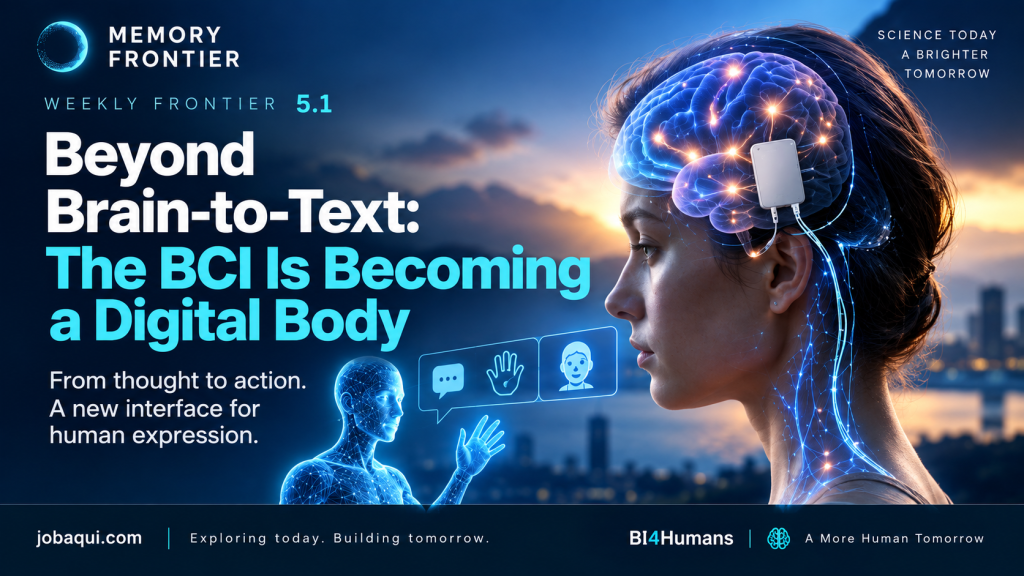
A brain-computer interface is beginning to restore more than words: it can restore expressive digital presence.
Brain-computer interfaces have already shown that neural activity can be translated
into text or device control. A new peer-reviewed study pushes that idea further:
speech and non-verbal gestures were decoded in parallel
and used to drive text and a personalized full-body avatar in real time.
The important change is not only decoding a message. It is restoring multiple channels of expression.
Human communication is multimodal. We speak, gesture, point and use body movement
together. The study asked whether one implanted interface could decode more
than one intended expressive channel at the same time.
Neural Intent → Decode Speech + Gesture → Text + Avatar → Visible Expression
Communication is richer when the body can speak along with the words.
For people with severe paralysis, a communication system that produces only text
may restore an important channel while still leaving out gestures and body
language. A multimodal BCI can begin to return some of that expressive layer.
That does not make the interface a digital replacement for the body. It shows a
credible path toward assistive systems that represent more of a user’s intended expression.
One implant supported parallel decoding of intended speech and upper-body gestures.
The Nature Neuroscience study used high-density electrocorticography in three
participants with severe paralysis. Neural patterns related to attempted
speech and movement were distinct but partly overlapping.
Speech Intent + Gesture Intent → Shared Neural Interface → Multimodal Output
Models trained with both isolated and simultaneous behaviors performed better
across contexts, showing that deployment conditions matter when training
neural decoders.
The BCI question is shifting from
“Can neural activity produce text?”
toward
“Can neural intent restore expressive presence?”
Decoded neural intent became visible communication in real time.
Decoded speech appeared as text while decoded gestures animated a personalized
full-body avatar. That combination matters because communication is not
naturally divided into isolated channels.
The result remains early. The study involved three participants for neural
movement data, while simultaneous speech-and-gesture avatar demonstrations
involved two participants and restricted vocabularies.
The frontier signal is therefore specific: richer assistive digital embodiment
is becoming technically plausible, but broad everyday communication still
requires substantially more validation.
The value may come from restoring more of the social meaning carried by movement.
A gesture can clarify intent, direct attention or add emotional and social context.
Mapping intended movement into an avatar creates a route for those signals
to re-enter digital communication.
Neural Intent → Multimodal Decode → Digital Body → Richer Expression
The deeper idea is not an avatar as decoration. It is an avatar as an assistive
output channel controlled by the user’s own intended actions.
Richer neural interfaces also make privacy, consent and user control more important.
As BCIs decode more expressive information, system design must consider who can
access neural data, how long it is retained, what outputs are generated and
whether the user can clearly control or stop the interface.
- Neural-data privacy
- Explicit consent
- User control of output
- Secure storage and transmission
- Identity and avatar representation
- Clear start and stop controls
- Clinical validation
- Accessible interface design
- Transparent limitations
The demonstrated target is assistive communication for people with severe paralysis.
Restoring expressive communication can affect agency, social participation and
quality of life. The study should not be generalized into claims about
enhancement for healthy users or unrestricted mind reading.
Assistive Need → Neural Intent → Decoded Expression
More Capability → More Validation + User Control
The objective is not to decode everything in the brain. It is to reliably restore
intended communication while preserving the person’s control and privacy.
A useful BCI closes the loop between intention and visible expression.
Intend → Record → Decode → Express → Observe → Adjust
This creates a useful way to think about neural avatars. The implant and decoder
translate intended action into output, while the user sees the result and
can continue, change or stop the interaction.
Brain-computer interfaces are moving from single-output control toward digital embodiment.
Earlier BCIs often focused on one output at a time: a cursor, text or a robotic
control channel. Multimodal decoding points toward interfaces that may
eventually support more natural combinations of intentional expression.
The emerging thesis is
neural intent + multimodal decoding + digital embodiment +
user control.
The frontier is not mind reading. It is assistive expression becoming richer.
Explore the neural-avatar frontier in greater depth
The complete Article-Training provides a guided exploration through:
- Learning modules
- 24 interactive practice cases
- Brain-computer interface fundamentals
- Speech-and-gesture decoding
- Neural avatar concepts
- Evidence-boundary reasoning
- Privacy and user-control decisions
- Critical-thinking exercises
- English / Spanish learning experience
- Participation tracking
- Research grounding
- Certificate of Participation
This study should not be interpreted as general mind reading, a finished consumer
product or evidence that arbitrary private thoughts can be reconstructed.
The demonstrated result is narrower: high-density cortical recordings supported
simultaneous decoding of intended speech and gestures in a small number of people
with severe paralysis, including real-time control of text and an avatar.
Continue with the complete learning experience
Explore the complete interactive learning experience, work through the
24 practice cases, and generate your Certificate of Participation.