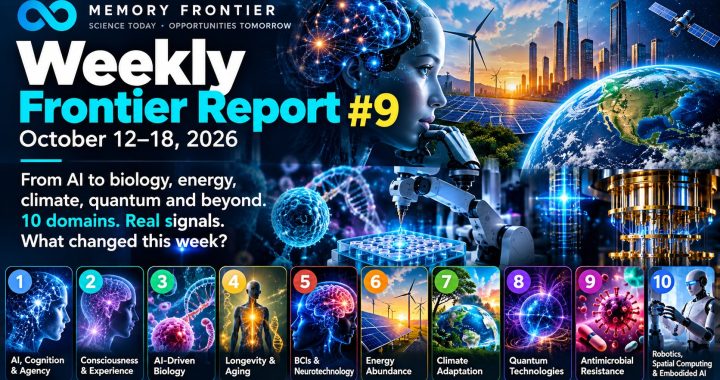
4 quick signals to understand the week
If you only read one section, read this
1000sdesigns tested
AI can design biology faster than labs can validate it
The story is not that AI “solved biology.” Design is accelerating so fast that experimental validation is becoming the new bottleneck.
62people imaged
Altered consciousness looks structured and context-sensitive
Brain changes under psilocybin were organized around context and changes in self/world boundaries — not simply random noise.
NOWmigration problem
Post-quantum security has moved from invention to deployment
The practical challenge is inventory, coordination, implementation and migration across real organizations and systems.
What happened — and why a normal person should care
AI-discovered ideas can spread through human groups
A study found that useful strategies discovered by AI can be learned by people and then continue spreading through human groups.
Altered consciousness may be organized, not just chaotic
Brain imaging under psilocybin showed structured changes that depended on context, suggesting altered consciousness is not simply “more disorder.”
AI can design proteins faster than labs can test them
Computers can propose many biological designs, but experiments still decide which ones actually work.
Aging research is getting better at measuring change
Researchers compared many aging clocks and found some are more responsive to interventions than others. Wearables are also adding useful long-term signals.
No major BCI breakthrough — but the architecture is improving
This week was more about combining brain interfaces with low-power brain-inspired computing than about a dramatic new implant.
Energy progress came from several technologies at once
Sodium-ion batteries, more efficient solar cells and supply-chain investment all moved forward. The story is stacked progress, not one miracle technology.
Climate solutions have to survive real-world constraints
Better climate planning connects physical risks to practical decisions and tests whether carbon-removal ideas still work outside ideal models.
Post-quantum security is now mostly a migration problem
The algorithms are increasingly available; the hard part is moving organizations, systems and deadlines to them before the threat arrives.
Faster diagnosis can reduce blind antibiotic use
Rapid blood testing identified infections sooner, helping doctors target antibiotics earlier instead of relying as long on broad-spectrum treatment.
Robots are learning to feel contact, not only see
An aerial robot used a tactile hand to perch, showing why physical intelligence needs feedback from touch as well as cameras.
Prediction becomes more useful when reality can answer back
Across the week, the recurring pattern was predict → test → observe → update.
AI designs proteins but the lab decides; robots act but touch corrects them;
aging interventions need longitudinal biomarkers; climate ideas meet physical constraints.
→
🧠 Understand
→
💡 Reason
→
⚙️ Act
→
📊 Measure
→
🔧 Correct
→
📚 Learn
Three topics worth teaching to a general audience
AI + biology
AI Can Design Proteins — But Biology Still Gets the Final Vote
Consciousness + context
When the Boundary Between Self and World Changes
Post-quantum migration
The Algorithms Exist; Migration Is the Hard Part
🧪 A strong signal means the evidence deserves attention — not that a technology is finished,
safe, inexpensive or ready for mass use. When the evidence is thin, the correct answer is WATCH,
not to manufacture a breakthrough.